

Agentic AI is reshaping how businesses automate complex workflows. Unlike a chatbot that waits for instructions, an autonomous AI agent reasons through a goal, breaks it into steps, and executes them independently — using tools, APIs, and real-time data to get results.
Agentic AI refers to AI systems that perceive their environment, set goals, plan multi-step actions, and execute those actions autonomously — without requiring human input at each step. Unlike generative AI, which responds to prompts, agentic AI acts, adapts, and learns across extended tasks.
What Is Agentic AI?
Agentic AI refers to artificial intelligence systems that pursue goals autonomously — planning sequences of actions, using tools, and adapting based on outcomes — without requiring a human prompt at each step. Unlike traditional software that executes fixed rules, agentic systems decide how to accomplish an objective, not just what to compute.
The reasoning layer underneath these systems is typically a large language model such as GPT-5 or Claude Opus 4.8. These models interpret goals, break them into sub-tasks, and direct tool use — from web search to code execution to API calls — across multiple steps in a single run.
Tooling infrastructure like the OpenAI Agents SDK makes it practical to wire these capabilities together in production. Developers can define agent roles, handoff logic, and guardrails in code, turning a capable language model into a reliable, goal-directed system rather than a single-turn chatbot.
How Does Agentic AI Work?
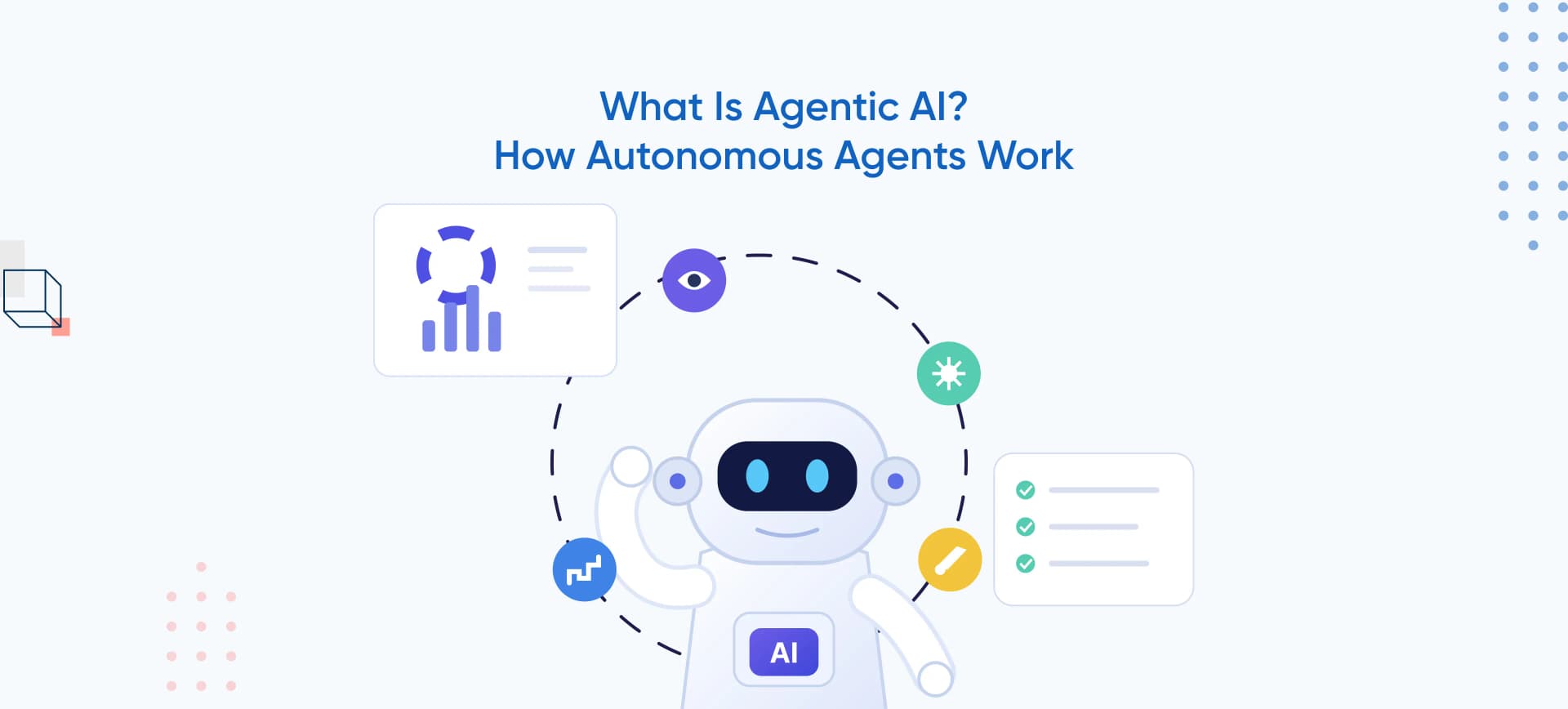
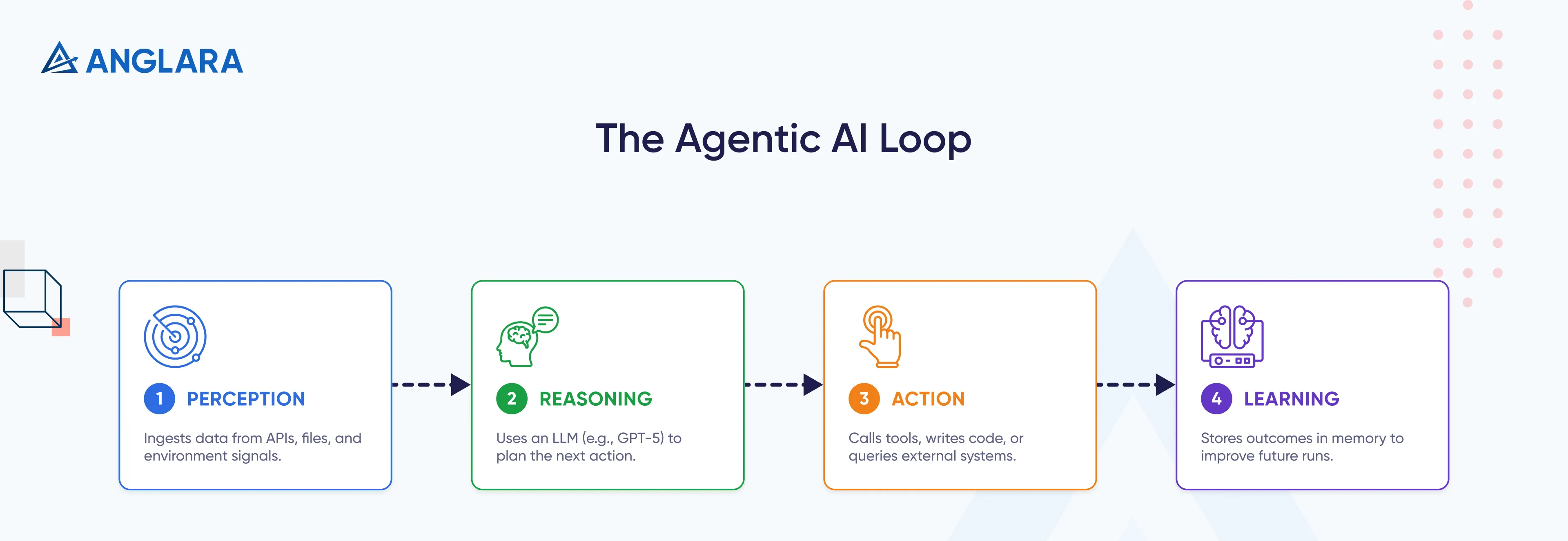
Agentic systems follow a continuous loop of four stages. Each stage builds on the last, allowing the agent to stay on task across multi-step workflows.
Perception
The agent ingests input — user instructions, database records, API responses, or file contents. It converts unstructured information into a structured context the reasoning layer can act on. Richer input handling directly improves the quality of downstream decisions.
Reasoning
A large language model like GPT-5 or Gemini 3.5 Pro evaluates the current context, compares it against the goal, and selects the next action. This is where AI decision-making happens: the model weighs options, accounts for prior steps, and generates a plan rather than a single answer.
Action
The agent executes its chosen action — calling an API, writing a file, querying a database, or spawning a sub-agent. Frameworks such as the OpenAI Agents SDK handle tool registration and safe execution boundaries, which is a key reason open ai stock in AI infrastructure tooling has drawn sustained enterprise interest.
Learning
After each action, the agent observes the result and updates its working context. It does not retrain its weights in real time, but it adjusts its plan based on what succeeded or failed, allowing it to recover from errors and refine its approach within the same session.
Types Of AI Agents
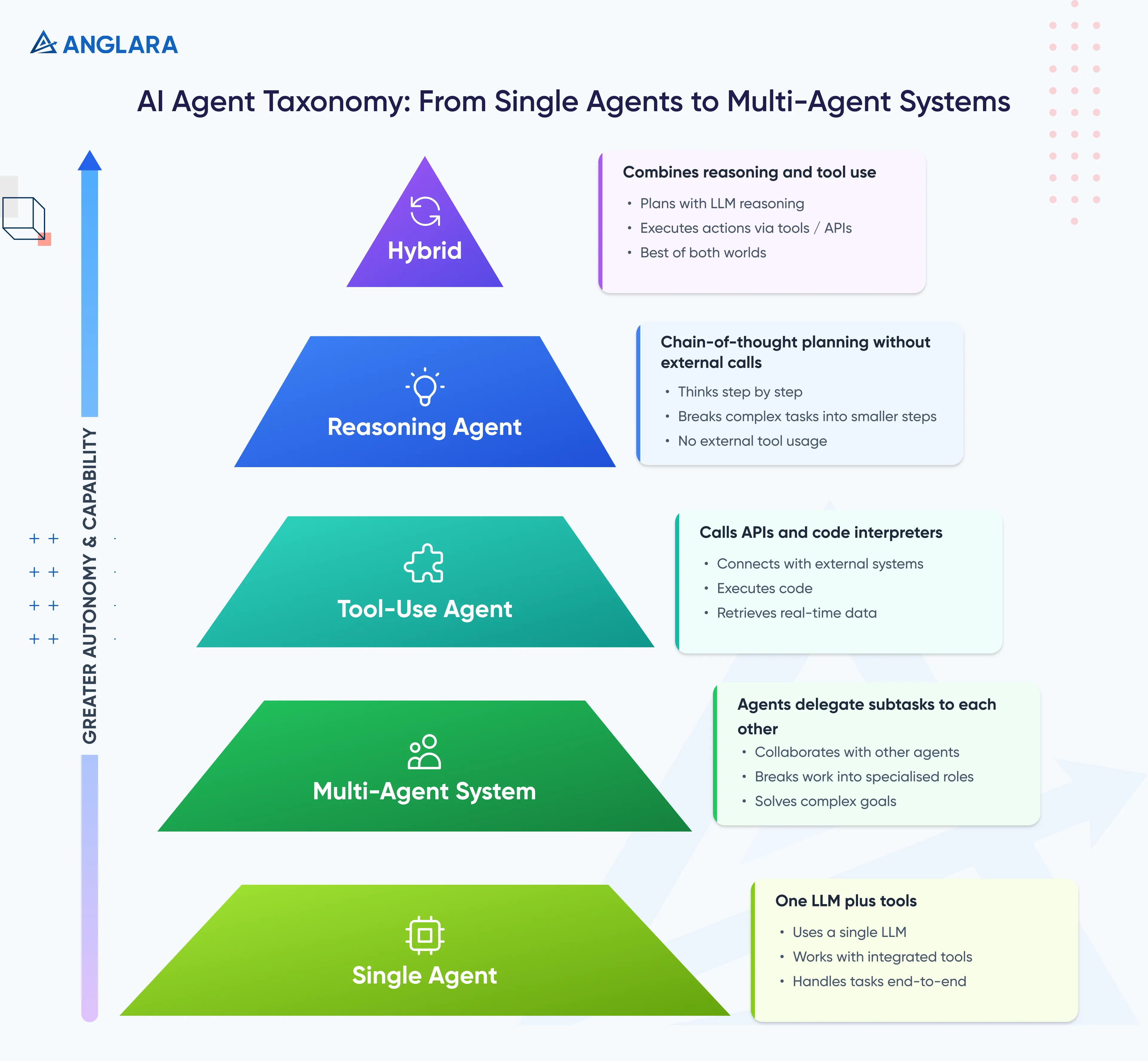
Not every agentic AI system is built the same way. Understanding the main categories helps teams choose the right architecture before committing to a build.
Single-Agent Systems
A single autonomous AI operates within a defined scope — one goal, one toolset, one context window. These agents suit well-bounded tasks: drafting and sending a report, monitoring a data feed and alerting on anomalies, or executing a scripted support workflow. Google Agentspace, Google's enterprise agent platform, offers pre-built single-agent configurations that connect to Workspace data, making deployment faster for teams already inside that ecosystem.
Multi-Agent Systems
Multi-agent systems assign specialised roles to separate agents that coordinate toward a shared objective. An orchestrator agent breaks down the goal; worker agents handle research, code generation, or data retrieval in parallel. This architecture handles complexity that exceeds a single context window and enables genuine parallel processing. For teams without engineering resources, a no-code AI agent builder — such as those available through platforms like Zapier or Microsoft Copilot Studio — can wire together simple multi-step agent flows without writing code, though production-grade systems generally require custom development.
Agentic AI vs. Generative AI
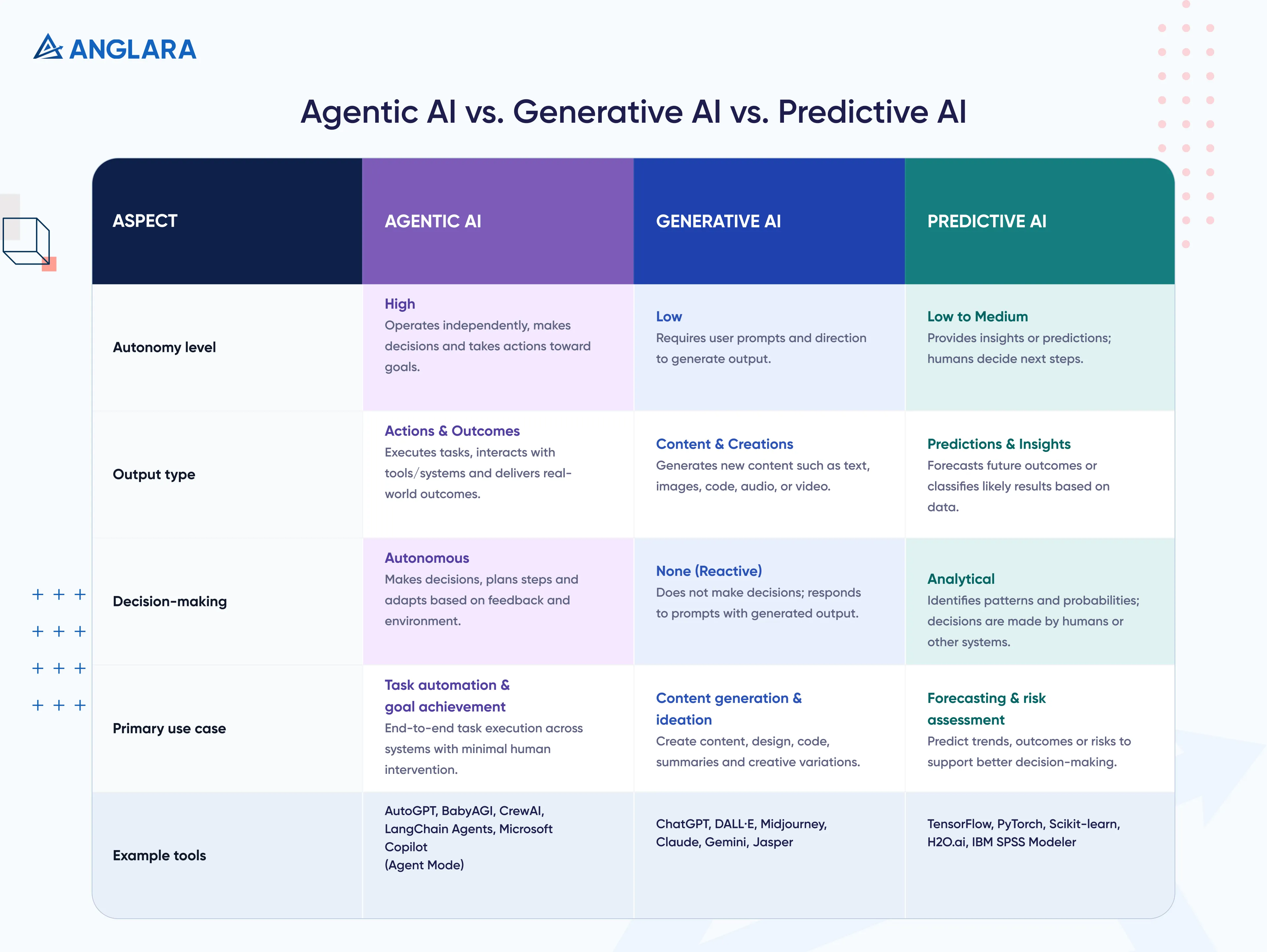
Generative AI produces content — text, images, code — in response to a prompt. Agentic AI acts. The distinction matters because many teams that have already deployed generative AI tools assume they are operating agentic systems; they are not.
A generative AI model like GPT-5 answers a question and stops. An agentic system receives a goal, plans the steps required to reach it, executes tools, checks results, and continues until the objective is met or a human intervenes. The decision-making is distributed across a full run, not concentrated in a single generation step. Teams evaluating whether to extend their current generative AI stack should also consider whether a no-code AI agent builder can meet their needs before investing in a fully custom architecture.
Agentic AI Use Cases
The practical value of agentic AI becomes clearest when mapped to specific operational problems teams already face.
Enterprise Workflow Automation
In enterprise AI deployments, agentic systems eliminate the manual handoffs that slow down repeatable processes. A sales operations team can deploy an agent that monitors CRM activity, identifies stalled deals, drafts personalised outreach, and logs the action — without human intervention at each stage. Customer service teams use agents to handle escalation routing: the agent reads ticket history, assesses urgency, and transfers the case to the right specialist queue with a pre-written summary. Microsoft Semantic Kernel is a common orchestration layer in enterprise workflow automation builds, allowing developers to chain agents across Microsoft Azure services with consistent memory and planning primitives.
Industry-Specific Applications
Healthcare providers use agentic AI for triage routing — agents read incoming patient intake forms, cross-reference symptom profiles against clinical decision rules, and assign priority levels before a clinician reviews the case. Marketing teams deploy agents that pull campaign performance data, identify underperforming segments, and generate copy variants for A/B tests within the same session. Legal and compliance teams use document-review agents to flag clauses that deviate from standard contract language, reducing review time on high-volume deal flows. Each of these applications shares a common pattern: a goal that requires multiple tools, sequential decisions, and an output that drives a real action.
Challenges And Risks Of Agentic AI
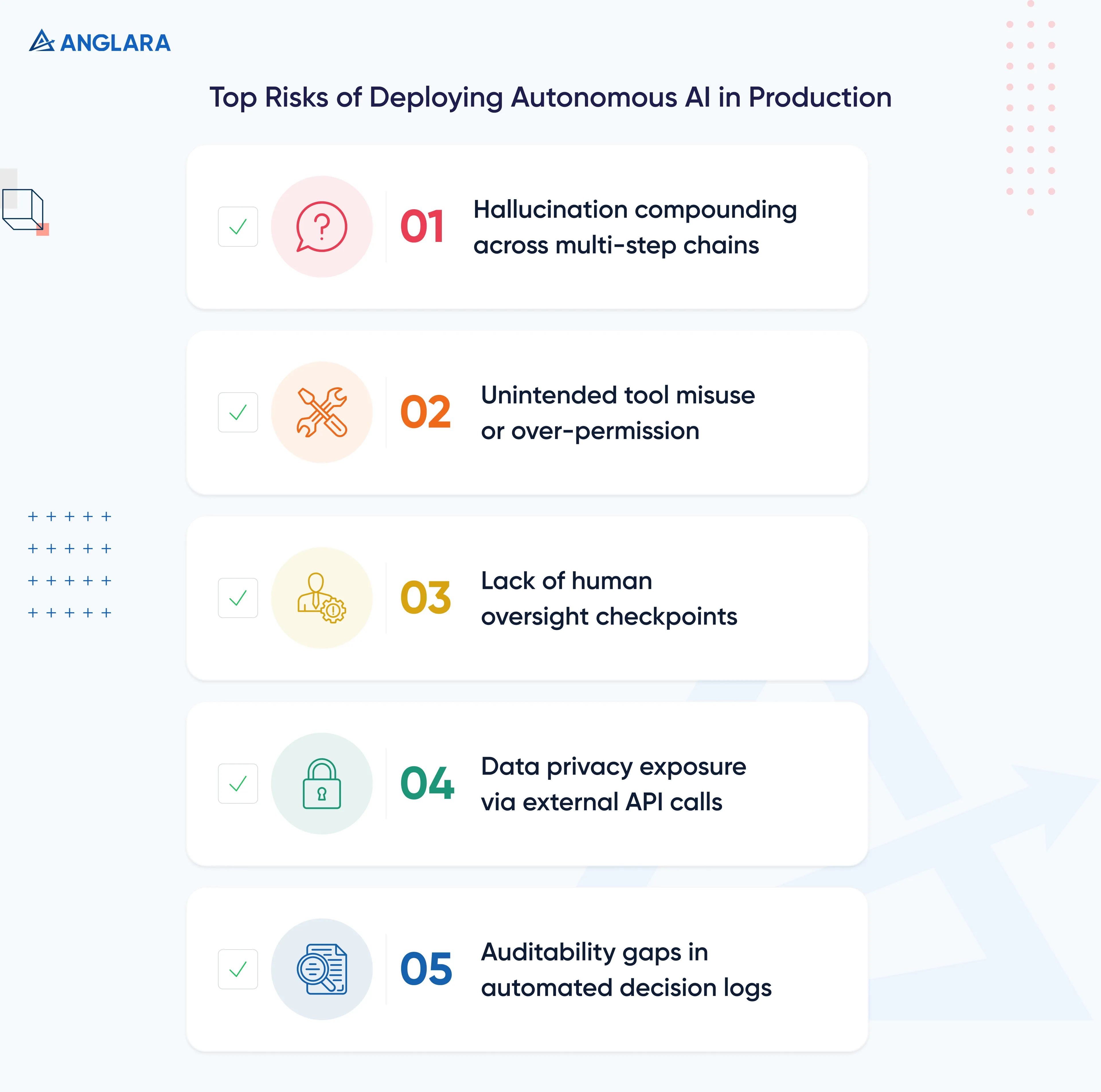
Agentic AI introduces risks that single-turn generative AI does not. Teams that ignore them typically discover them in production at the worst possible moment.
Hallucination compounding is the most serious. When a language model makes a confident but incorrect inference early in a multi-step run, every subsequent action builds on that error. The final output can be plausibly structured but factually wrong in ways that are hard to trace without full run logging.
Tool misuse is a related risk. Agents given write access to databases, email systems, or payment APIs can execute irreversible actions. Without well-defined permission scopes and confirmation checkpoints, a misconfigured agent can send bulk emails, delete records, or trigger financial transactions before a human can intervene.
Oversight gaps emerge as agent runs grow longer and more complex. Most teams underestimate how quickly autonomous AI behaviour becomes difficult to audit. Structured logging, human-in-the-loop checkpoints at critical decision nodes, and role-based access controls are not optional — they are the minimum governance baseline for any production agentic system.
Data privacy is also a live concern. Agents that retrieve, process, and transmit information across external APIs may expose personally identifiable data to third-party services. Legal review of the data flows an agent can initiate should precede deployment, not follow it.
Is This Right For You?
Agentic AI solves real problems, but it is not the right solution for every team or every project. Being clear about fit upfront saves significant time and budget.
This approach is not a good fit if:
- Your task is a single-step operation with no tool dependencies — a standard generative AI call will perform better and cost less
- Your team has no AI governance process in place — deploying autonomous AI without oversight frameworks creates compliance and operational risk before you see any benefit
- Your timeline requires a same-week launch — production-grade agentic systems require architecture decisions, security review, and testing that cannot be compressed into days without meaningful quality trade-offs
Frequently Asked Questions
What is Togal AI and how does it relate to agentic systems?
Togal AI is an AI-powered takeoff platform built for construction estimators. It uses computer vision to automate quantity takeoffs from blueprints. While it automates a specific task, it is purpose-built rather than a general agentic AI system — it does not plan multi-step goals or use external tools dynamically.
What is the OpenAI login and why does it matter for developers?
Open AI login refers to accessing your OpenAI account, which gates your API keys, usage limits, and model access. Developers need it to connect applications to GPT-5 or other models via the OpenAI API. Without a valid account, you cannot call the OpenAI Responses API or use the Agents SDK.
What is agentic AI vs generative AI vs predictive AI?
Generative AI creates content from a prompt. Predictive AI forecasts outcomes from historical data. Agentic AI does both and more — it sets goals, reasons through steps, uses tools, and takes actions autonomously across time. Agentic systems often use generative AI as their reasoning engine inside a larger decision-making loop.
What is a free AI agent builder and is it reliable for production use?
A free AI agent builder is a no-code or low-code platform — such as a free tier of LangGraph, Flowise, or similar tools — that lets teams prototype agents without writing orchestration code from scratch. Free tiers work for evaluation but typically lack the reliability, security, and observability needed for production enterprise workflows.
What is the difference between AutoGen and LangChain for building agents?
AutoGen, from Microsoft, is designed specifically for multi-agent conversation workflows where agents collaborate or debate to solve tasks. LangChain is a broader orchestration framework for chaining LLM calls, tools, and memory into pipelines. AutoGen suits agent-to-agent coordination; LangChain suits flexible single-agent pipelines with extensive tool integrations.
What does the engagement process look like when working with Anglara?
After your first message, Anglara responds the same business day. We begin with a scoping call to understand your automation goals, then move into a fixed-scope or milestone-based contract. Most MVPs are delivered in six to ten weeks. An NDA is available before any technical discussions, and there is no obligation to proceed after the initial consultation.