

Outsourcing now accounts for a significant share of global software spending — and yet Deloitte's Global Outsourcing Survey consistently finds that cost savings, not strategic fit, drive most vendor decisions. That mismatch is where projects quietly go wrong.
Choosing between offshore, nearshore, and onshore software development is not just a budget call. It shapes your timezone overlap, your communication rhythm, your IP exposure, and ultimately whether your product ships on schedule.
This guide breaks down all three models honestly — including where each one typically falls short.
By the end, you will know which model fits your situation, what the hidden costs look like, and when a hybrid approach might serve you better than committing to any single model.
Nearshore software development companies are vendors located in a nearby country or region — typically sharing a similar timezone with the client — which reduces the communication friction common in fully offshore arrangements.
Offshore development (such as teams in India or Eastern Europe) offers the widest talent pool and the lowest blended hourly rates, but requires deliberate process investment to manage async collaboration well.
Onshore development keeps everything in the same country and timezone, which simplifies communication and legal clarity but typically carries the highest cost.
The right model depends on your budget, how tightly your team needs to collaborate, your IP sensitivity, and how much management bandwidth you can realistically invest.
Most mid-market companies end up using a blend of two models rather than committing to one exclusively.
Who This Is For
This guide is written for decision-makers who are staffing or scaling a software team and are actively weighing whether to hire locally, work with a nearshore development team, or partner with an offshore vendor like Anglara.
If you have already outsourced and hit friction, this comparison may help you diagnose what went wrong.
- CTOs and engineering leads evaluating cost-effective ways to extend a core team
- Product owners who need faster execution without losing visibility or quality
- Founders at seed-to-Series B companies building their first external dev relationship
- RevOps or operations leaders managing vendor relationships and looking to reduce delivery risk
Why Picking The Wrong Outsourcing Model Costs More Than Hiring Local
The spreadsheet makes offshore look obvious. A senior developer in India or Eastern Europe often costs a fraction of the equivalent US or UK market rate.
But the Standish Group's CHAOS Report has long documented that a significant proportion of outsourced software projects run over budget or over schedule — and timezone misalignment, unclear ownership, and communication breakdown are among the most commonly cited root causes.
The math changes fast when you factor in management overhead. A US-based engineering manager spending four hours a week bridging an offshore team is carrying an invisible cost.
Multiply that across sprint cycles, rework loops, and delayed decisions waiting for a morning standup to surface a blocker from the previous afternoon, and the savings narrow considerably.
Nearshore software development services emerged partly as a response to this.
Companies in the US working with teams in Mexico, Colombia, or Brazil, and UK companies working with teams in Poland, Portugal, or Romania, found that shared (or close) timezone overlap reduced async friction without fully surrendering the cost advantage.
But nearshore is not automatically better — it depends entirely on what your bottleneck actually is.
What Offshore, Nearshore, And Onshore Development Are — And How They Work
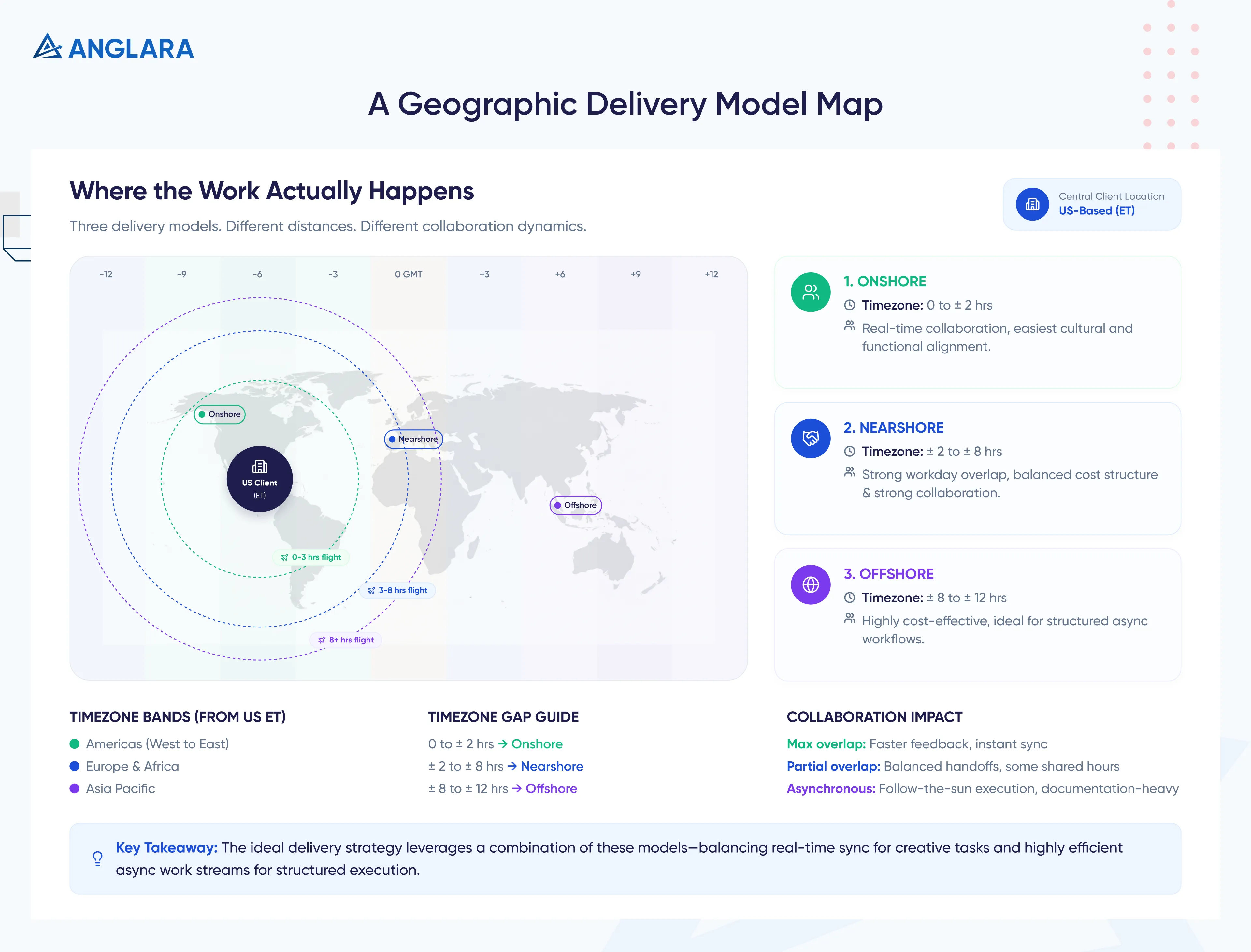
The three models are defined primarily by geography and the timezone relationship between the client and the vendor team. Each carries a different cost profile, collaboration dynamic, and risk exposure.
Understanding the structural difference between them is the starting point for making a sound decision.
Key Components Of Each Delivery Model
Offshore development places the vendor team in a geographically distant country — typically 5 to 12 hours apart from the client.
India is the most established offshore destination globally, with NASSCOM reporting that India's technology sector exports exceeded $250 billion in FY2024. The cost advantage is real and significant.
The challenge is almost always collaboration cadence: async-by-default workflows require strong documentation habits, clear sprint rituals, and a client-side liaison who can make decisions without waiting 24 hours for a response.
Nearshore development sits in the middle — the vendor is in a neighboring country or region, typically within 0 to 3 hours of the client's timezone. For US companies, this usually means Latin America.
For UK and EU companies, it often means Central or Eastern Europe. The overlap window is wide enough to run live standups, unblock issues in real time, and conduct code reviews synchronously.
The rate advantage over onshore is usually 30–50%, depending on the specific country and role seniority. Onshore development keeps the vendor in the same country as the client.
Communication is frictionless, legal jurisdiction is clear, and cultural alignment is typically strong. The cost is proportionally the highest — and for many SMBs, it makes certain projects economically unviable without significant trade-offs elsewhere.
Offshore Vs Nearshore Vs Onshore: Side-By-Side Comparison
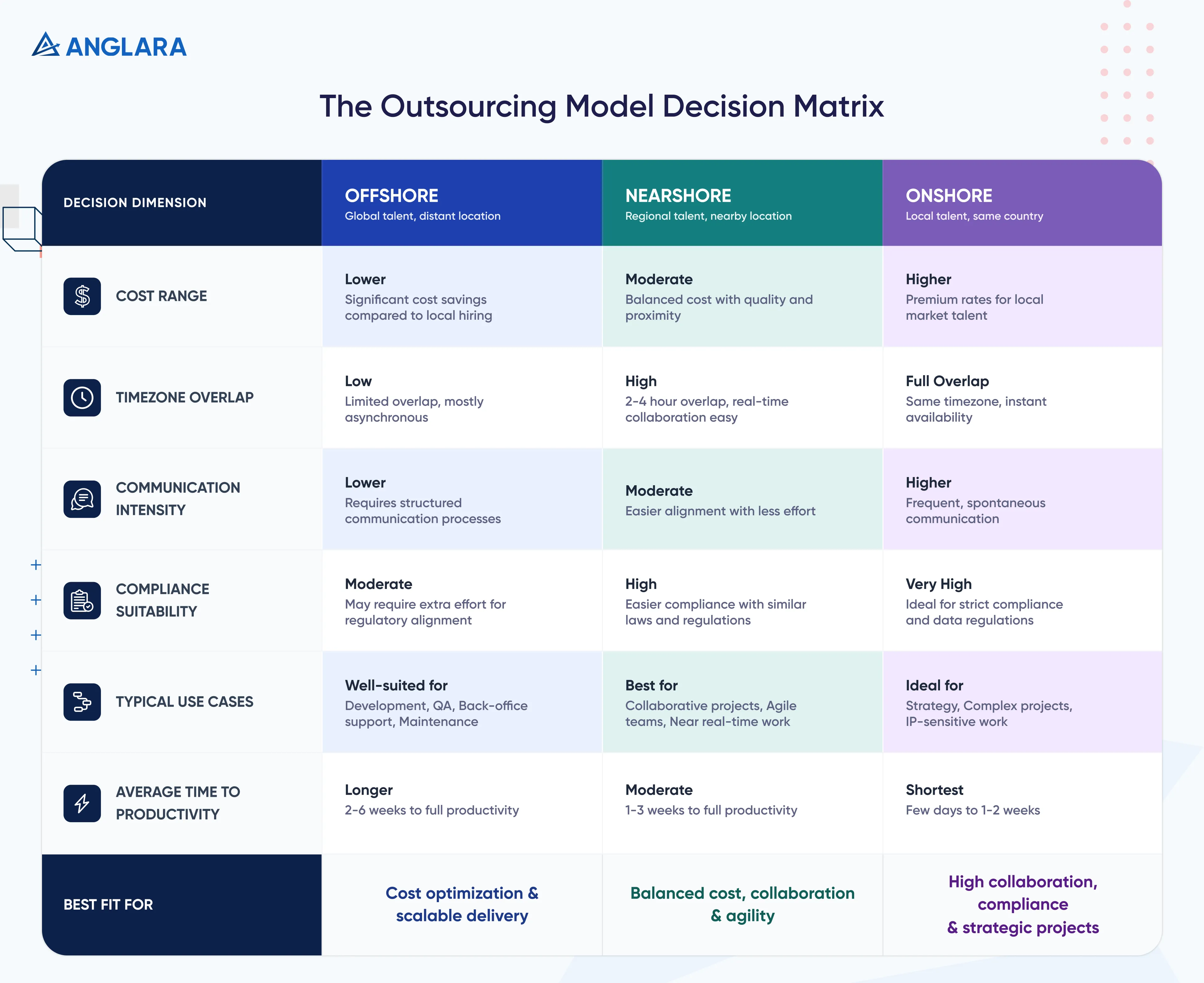
The table below summarizes the five dimensions that matter most when choosing a software development delivery model. Use it as a starting point — your specific situation will shape the weighting.
Comparison At A Glance
| Dimension | Offshore (e.g., India) | Nearshore (e.g., LatAm / Eastern Europe) | Onshore (US / UK / EU) |
| Typical blended rate | $25–$60/hr | $45–$95/hr | $100–$200+/hr |
| Timezone overlap | Low (0–4 hrs with US/UK) | Medium to high (3–8 hrs) | Full |
| Communication style | Async-first; strong docs required | Hybrid; real-time possible | Synchronous by default |
| IP and legal clarity | Moderate; requires contractual care | Moderate to strong | Strongest |
| Best for | Cost-sensitive builds, large teams, established workflows | Collaborative sprints, regulated industries, fast iteration | High-sensitivity projects, regulated US/UK work, fully integrated teams |
A few caveats worth naming. Hourly rate ranges vary significantly by seniority, tech stack, and vendor type.
A well-run offshore engagement with strong delivery infrastructure often outperforms a poorly managed nearshore team — the model is one variable, not the only one.
Also worth noting: the 'IP and legal clarity' row is not about offshore being untrustworthy.
It is about which jurisdiction's contract law and data protection regulations apply, how enforceable NDAs are in practice, and whether your vendor has the right data processing agreements in place for GDPR or HIPAA requirements.
These are solvable — but they require deliberate contractual setup, not an assumption.
What Teams Usually Underestimate
The hourly rate is the most visible number in any vendor comparison.
The real cost of a poorly scoped offshore or nearshore engagement often lives in rework cycles, delayed standups, and the engineering manager hours spent bridging gaps that were not budgeted for.
Hidden Costs Most Teams Do Not Put On The Spreadsheet
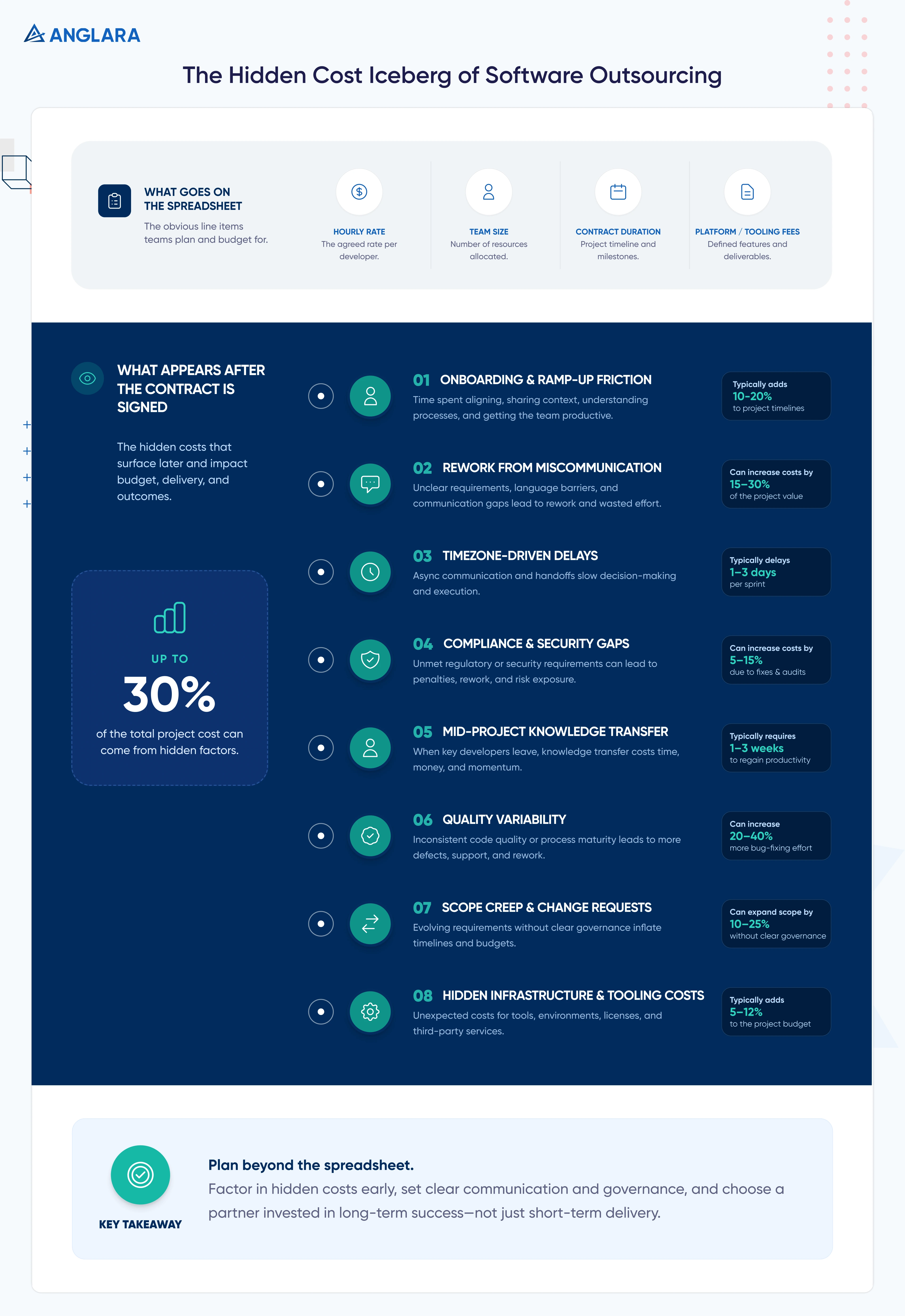
Most outsourcing decisions are made on a rate card. The real financial picture is wider than that — and the gap between the two is where many engagements quietly underperform.
The Costs That Appear After The Contract Is Signed
Onboarding and ramp time is the first invisible line item. A new offshore or nearshore team typically needs 4 to 8 weeks before they are operating at full productive velocity.
During that window, your internal engineers are spending time on knowledge transfer, not on their own roadmap. That ramp period is often treated as zero-cost in vendor comparisons — it is not.
Churn and continuity risk is the second. Offshore and nearshore teams serving multiple clients simultaneously may rotate developers between accounts. When a lead developer who understands your system leaves, the institutional knowledge they carried leaves with them.
Re-onboarding a replacement carries the same ramp cost, repeated.
Management overhead is the third. For offshore arrangements in particular, a client-side technical liaison — often a senior developer or engineering manager — is essential for bridging async gaps, reviewing work, and making fast decisions.
That person's time is typically not counted in the vendor's hourly rate but is a real cost to the engagement.
Currency and contract risk, compliance preparation (especially for GDPR or HIPAA-adjacent work), and tool licensing for collaboration infrastructure round out the list. None of these are reasons to avoid offshore or nearshore development.
They are reasons to budget for them and build them into your vendor selection criteria from the start.
Real Delivery Examples From Anglara Project Work
The strongest implementations share one thing: the delivery model was chosen to match the project's actual constraints, not just its budget.
Travel: Moving 90% Of Operations Online With A Self-Serve B2B Portal
A mid-market B2B travel company was managing bookings through calls, WhatsApp, and spreadsheets. Agents had no self-serve tools to compare rates, build quotes, or complete bookings independently.
The portal was architected using a progressive web app development approach, enabling the client's partners to access the platform across devices without requiring native app distribution.
The result was slow turnaround, limited visibility for leadership, and rising operational cost with no clear audit trail.
Anglara built a modular B2B portal that centralized hotel, rate, and offer management alongside a self-serve agent desk for end-to-end bookings.
The rollout used value-first increments — shipping usable functionality early rather than waiting for a full build — which kept adoption high and reduced the risk of building features no one used.
The outcome: 90% of operations moved online, manual work dropped sharply, quote speed improved, and leadership gained clean, actionable booking data with full status visibility.
This project illustrates how offshore software development nearshore-style collaboration habits — frequent incremental delivery, stakeholder-aligned sprints, and tight feedback loops — can close the communication gap that often plagues large offshore engagements.
See how we built it. You can also read the verified client review on Clutch.
Arts And Entertainment: A High-Performance Website With Measurable UX Impact
An improv comedy theatre had a credibility problem online. Visitors struggled to find show schedules, class information, and contact details because the site's navigation was unclear and content updates required developer involvement.
For a venue that runs on ticket sales, a poor digital experience has a direct revenue cost.
Anglara delivered an end-to-end website redesign — from information architecture and UX design through to responsive development and CMS configuration — that gave the theatre team full content control without needing a developer for routine updates.
The site achieved a 90+ performance score, and the improved UX contributed to an increase in ticket sales alongside strongly positive audience response to the new design.
For projects like this — where the scope is well-defined, the timeline is tight, and the deliverable is a polished public-facing product — offshore development with the right process discipline is often indistinguishable in outcome from working with a local agency.
Healthcare: Stopping A High-Stakes Security Threat With AI-Assisted Detection
A multi-facility healthcare provider was running fragmented security tooling across endpoints, firewalls, EHR access logs, and identity systems.
The detection layer in this engagement was built using Anglara's custom AI development services, applied within a nearshore delivery structure that allowed daily clinical and engineering collaboration.
Threat detection was slow, and their rules-based approach was missing the behavioral patterns that precede lateral movement and privilege escalation attacks — exactly the kind of activity that often goes undetected until it is too late.
Anglara built an AI-assisted security layer that ingested telemetry from all of those sources and flagged risky behavior in real time.
Automated playbooks were configured to isolate compromised devices and revoke tokens within minutes of a detected threat — without requiring a human in the loop for every response.
The system stopped an attack path that would have exposed critical systems and halted operations, averting losses estimated at up to £10M.
This is the kind of engagement where IP sensitivity, data residency requirements, and strict contractual controls were non-negotiable — demonstrating that offshore delivery is viable for regulated industries when the vendor invests properly in compliance infrastructure.
How To Choose The Right Model For Your Team
There is no universally correct answer. The right model depends on a combination of factors that are specific to your project, your team, and your organization's tolerance for async communication.
The framework below gives you a decision-starting point — not a decision shortcut.
When Offshore Development Is Typically The Right Call
Offshore works well when the project scope is well-defined, the client has an internal technical lead who can handle async review cycles, and the priority is maximizing development capacity within a constrained budget.
It also suits teams that have already built outsourced delivery muscle — they know how to write tight briefs, run async standups effectively, and avoid the meeting-heavy collaboration style that offshore timezone gaps make expensive.
For companies building on established tech stacks — NestJS or Laravel backends, Next.js frontends styled with Tailwind CSS — offshore teams in mature markets like India typically have deep, specialized talent available at multiple seniority levels.
The Stack Overflow Developer Survey 2024 consistently shows India among the top countries by developer population, which means vendor selection is competitive and quality varies — making due diligence and trial engagements worth the extra time upfront.
When A Nearshore Development Team Is Often The Better Fit
Nearshore software development services typically make the most sense when real-time collaboration is a genuine requirement — not a preference.
If your team runs live planning sessions, needs same-day code review turnaround, or is operating in an agile environment with short sprint cycles and frequent stakeholder touchpoints, the timezone overlap that nearshore companies provide has real operational value.
Nearshore outsourcing companies also tend to be a natural fit for regulated industries where client communication with legal or compliance teams needs to happen synchronously.
If you are a UK company working with an Eastern European nearshore development team, a 1–2 hour timezone difference is close enough to treat as a single working day.
For US companies working with LatAm teams, the overlap is often complete. The cost advantage is narrower than offshore — typically 30–50% below onshore rates rather than 60–70% — but for many teams that trade-off is worth it.
Teams evaluating nearshore partners for complex builds — including those requiring AI software development for enterprise applications — benefit most from partners who combine timezone proximity with domain-specific engineering depth.
When Onshore Is The Only Model That Actually Fits
Onshore development is worth the cost premium in a specific set of situations: projects with significant government or defense sensitivity, engagements where data residency requirements legally prohibit cross-border data transfer, and teams where the product is so tightly integrated with internal systems that daily in-person collaboration is genuinely necessary — not just preferred.
For most SMB and mid-market product builds, pure onshore development is economically difficult to sustain across a full project lifecycle.
Where it often shows up in practice is as a hybrid arrangement: an onshore technical lead or product owner working alongside an offshore or nearshore execution team.
That structure keeps decision-making local and fast while capturing the cost advantage of distributed execution.
What Anglara Would Do
At Anglara, we usually start with workflow clarity before vendor model selection.
Before recommending an engagement structure, we map out how the client's team actually makes decisions, how frequently they need to collaborate, and what the real bottleneck is — budget, speed, talent, or control.
The model selection follows from that, not the other way around.
When A Hybrid Model Outperforms Any Single Approach
A growing number of mid-market product teams are moving away from single-model outsourcing and toward intentionally blended arrangements. The logic is practical: different phases of a project have different collaboration and cost requirements.
How Hybrid Delivery Structures Typically Work
A common pattern is a nearshore or onshore product owner and architect working alongside an offshore execution team.
The client gets synchronous strategic collaboration for the decisions that matter most — scope changes, architecture calls, stakeholder reviews — while the larger volume of execution work runs offshore at a lower blended rate.
When implemented correctly, this model can match the communication quality of nearshore at a cost closer to offshore.
Another pattern is a phased model: start onshore or nearshore during the discovery and MVP phase (where iteration speed and communication density are highest), then transition to offshore for the scaling phase once the architecture is stable and workflows are established.
The ramp cost is paid once, and the team that built the system is still involved as it scales — just with a different cost structure.
Hybrid arrangements do introduce coordination complexity. Two vendor relationships, potentially two contracts, different tooling norms, and a client-side lead who can manage across both. That overhead is manageable for teams with some outsourcing experience.
For first-time outsourcers, it can add friction that offsets the benefit. Knowing which structure fits your team's maturity level is as important as knowing which model fits your budget.
If you are evaluating AI consulting or a custom web or mobile application build, the delivery model conversation is one Anglara typically has early — before quoting.
IP, Data Security, and Compliance: What You Need to Check
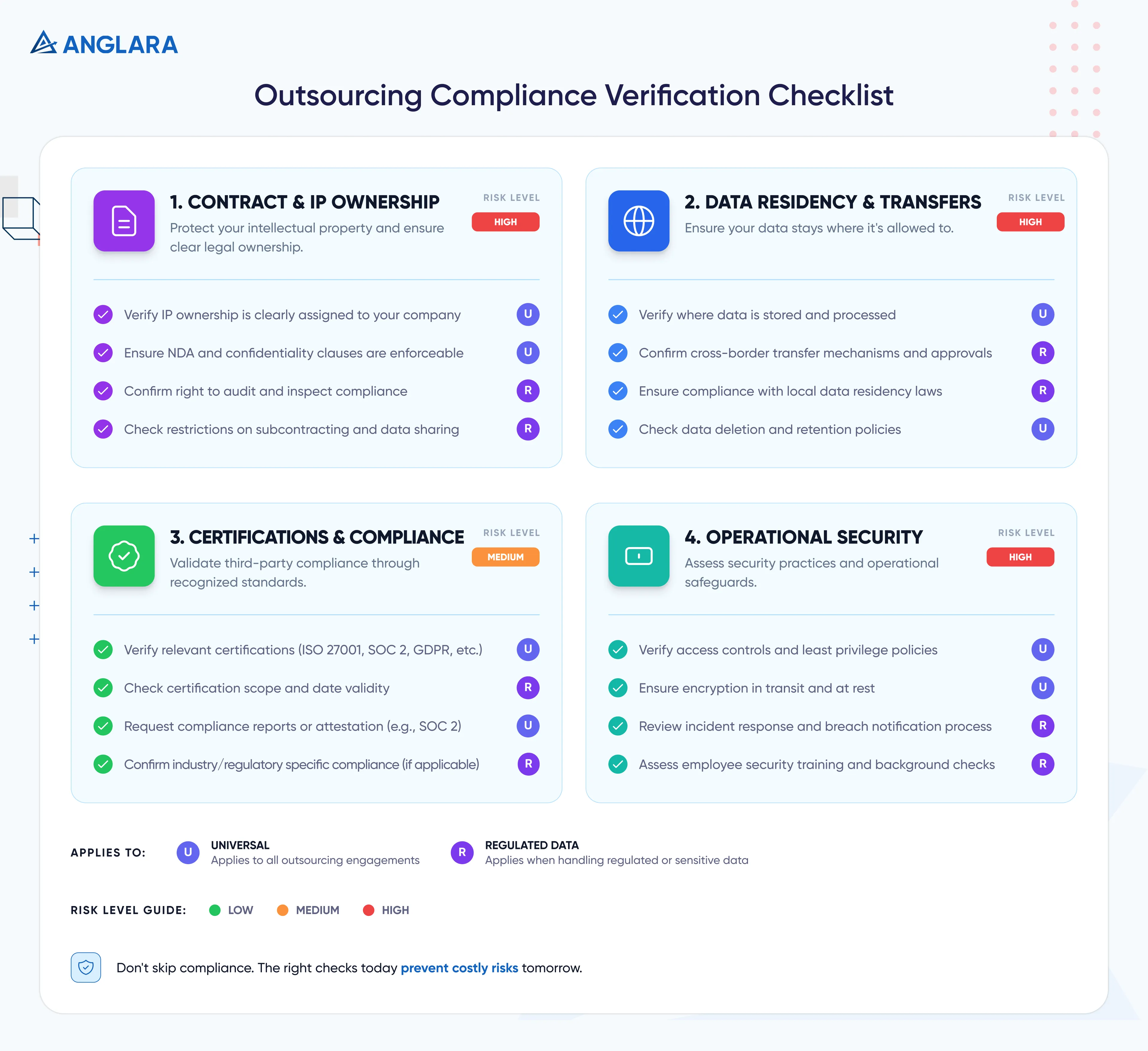
This section matters most for teams building in regulated industries or handling personal data from EU or UK users.
It is not a reason to avoid offshore or nearshore — it is a due diligence checklist that separates vendors who are compliance-ready from those who are not.
What to Verify Before Hiring an Outsourced Development Team
The GDPR requires that any organization processing EU personal data on behalf of a client — including an offshore or nearshore software development partner — operate under a valid Data Processing Agreement (DPA).
If your vendor cannot produce a DPA, that is a disqualifying gap, not a negotiation point.
For US teams handling protected health information, HIPAA's requirements around Business Associate Agreements (BAAs) apply regardless of where the vendor is geographically located.
Offshore does not exempt a vendor from HIPAA obligations if they are accessing or processing PHI on your behalf.
Beyond the contractual layer, practical IP protection comes from a combination of factors: assignment of IP clauses in the master services agreement, clear source code ownership terms, repository access controls, and confidentiality obligations that survive the engagement.
Most reputable offshore and nearshore outsourcing companies have standard templates for all of these — the check is simply whether the client's legal team reviews them, not whether they exist.
Where Implementation Often Breaks
The most common failure point in offshore and nearshore engagements is not technical skill — it is scope clarity at contract signing.
Teams that skip a structured discovery phase and hand vendors a rough brief end up absorbing the cost of ambiguity through change orders, sprint replanning, and rework that could have been avoided.
Not Sure Which Outsourcing Model Fits Your Project?
If you are at the stage of evaluating vendors and the model question is still open, a 30-minute conversation with Anglara's team can help you map the right structure before you commit.
We work with US, UK, and EU clients as an offshore partner — but we are honest about when a different model or a hybrid arrangement would serve you better.
Book a free 30-minute consultation — no pitch, just a focused conversation about your situation.
Or if you want to explore how we approach custom software development and AI consulting before getting on a call, those service pages cover our approach in more detail.
A Practical Checklist for Choosing the Right Outsourcing Model
Use these questions to pressure-test your model decision before committing to a vendor. They are not exhaustive, but they surface the variables that most commonly determine whether an engagement works.
- How frequently does your team need to collaborate in real time — daily, weekly, or by exception?
- Do you have an internal technical lead available to manage async communication and review cycles?
- Is the project scope well-defined enough to brief a team with limited back-and-forth, or is it still exploratory?
- Does your project involve personal data from EU or UK users, or protected health information? If so, is your vendor GDPR/HIPAA-ready?
- What is your real tolerance for ramp time — can the project absorb 4–8 weeks of onboarding overhead?
- Have you scoped the full cost of the engagement including management time, not just the vendor's hourly rate?
- Is the primary constraint budget, speed, talent availability, or control — and which model addresses that constraint most directly?
The Bottom Line on Offshore vs Nearshore vs Onshore
The decision between offshore, nearshore, and onshore software development is not a ranking — it is a fit question. Each model has genuine strengths, genuine limitations, and a set of conditions under which it performs best.
Offshore delivers the widest talent pool and the lowest blended rates, but requires process investment to overcome async friction. Nearshore closes the timezone gap at a moderate cost premium, making it well-suited for collaborative, iteration-heavy projects.
Onshore offers the simplest communication and the clearest legal framework, but at a cost that makes it difficult to sustain across large builds.
Hybrid arrangements — mixing models across phases or functions — are increasingly how mid-market teams capture the benefits of more than one approach.
The most common mistake is letting the hourly rate drive the decision before the collaboration and scope questions have been answered. Do the workflow analysis first. Then pick the model.
Anglara has been delivering software and AI projects from India for US, UK, EU, and Australian clients since 2017. We are an offshore partner — and we know how to make that work.
If you are at the evaluation stage and want a no-pressure conversation about what model makes sense for your specific situation, book a free 30-minute consultation with the Anglara team.
Benefits and Business Outcomes
Choosing the right delivery model does not just cut costs — it changes how fast your team can move, how reliably you ship, and how much technical debt you carry into year two.
Faster Time-to-Market Without Inflating Your Headcount
One of the most consistent advantages of nearshore and offshore delivery is speed to staff.
When a product team needs four backend engineers and a QA lead in under six weeks, hiring locally in London or San Francisco typically takes three to five months — if the talent exists at all.
Nearshore software development companies often maintain bench capacity and pre-vetted talent pools, which means onboarding can happen in two to four weeks rather than months.
For teams under delivery pressure, that difference is often what separates a Q3 launch from a Q1 one.
The operational math matters too. A nearshore development team that overlaps five to seven hours with your internal team can run daily standups, participate in sprint ceremonies in real time, and review PRs during your working day.
That rhythm typically reduces first-response lag from hours to minutes on active sprints.
Sustained Cost Efficiency Without Sacrificing Output Quality
Offshore and nearshore models often deliver meaningful cost differences compared to equivalent onshore capacity — not because the engineers are less capable, but because labor markets in India, Eastern Europe, and Latin America are structured differently.
According to Deloitte's Global Outsourcing Survey, cost reduction remains the primary driver for outsourcing decisions, cited by 70% of respondents.
The more important point is what that cost difference funds.
Teams that redirect savings from labor into product investment — better QA tooling, performance testing, UX research — often ship higher-quality software than teams that spent the same total budget on onshore contractors alone.
This dynamic is especially visible in web and application development.
Building a B2B portal or a mobile application with a nearshore team using Next.js and Laravel typically costs 35–55% less than an equivalent onshore engagement, without a material drop in delivery quality when the team is well-managed.
Access to Specialized Skills That Are Scarce or Expensive Domestically
AI engineering, DevOps automation, and full-stack development with modern frameworks are genuinely hard to hire for in many Western markets.
Senior engineers with production experience in NestJS or generative AI pipelines command salaries that are out of reach for most SMB and mid-market product budgets.
Nearshore and offshore models give those teams access to engineers who have shipped production-grade systems in those exact stacks — without the 18-month recruiting cycle or the six-figure salary commitment.
For specialized work like custom AI development or AI agent development, the offshore model often means the difference between doing it this year or not doing it at all.
This is particularly relevant for teams with a defined project scope. A six-month engagement to build a specific capability does not justify a permanent senior hire. An offshore or nearshore delivery model fits that time-boxed need far more cleanly.
Not Sure if Custom Is the Right Call?
Risks, Compliance, and Governance
Every delivery model carries risk. The question is whether you have identified it before the contract is signed — or whether you are discovering it during delivery.
Intellectual Property Exposure and Contract Gaps
IP ownership is one of the most commonly underestimated risks in offshore and nearshore engagements. Many teams assume that paying for the work means they own the output.
That is often true in practice — but only if the contract explicitly says so.
In some jurisdictions, default IP rules favor the creator, not the buyer. A contractor in a country with weak IP enforcement frameworks may retain moral rights to code or design even after payment.
The mitigation is straightforward: ensure your agreement includes a written IP assignment clause, specifies the governing law, and defines what happens to work-in-progress if the engagement ends early.
For any project touching healthcare data, financial records, or proprietary algorithms, have your legal counsel review the contract before signing — not after the first sprint has already shipped code.
This is especially true when working with offshore development teams in markets where enforcement mechanisms differ significantly from the US or UK.
Data Residency and Regulatory Compliance
If your product handles personal data from EU residents, you are subject to GDPR regardless of where your development team is located.
If your US-based healthcare application touches patient records, HIPAA requirements apply to every system that accesses or processes that data — including the tools your offshore engineers use day-to-day.
The practical risk is that teams focus compliance attention on their production environment and overlook the development environment.
If offshore engineers are working with real user data in a staging environment that lacks proper access controls, that is a compliance exposure — even if the production system is fully hardened.
Mitigation starts with a data classification policy before any external team is onboarded. Define which environments can contain real data, which must use anonymized or synthetic data, and what access logging is required.
Any credible nearshore software development company should be able to confirm their data handling practices in writing before work begins
Delivery Continuity and Single-Point-of-Failure Risk
One of the structural risks that surfaces mid-engagement is key-person dependency. A team that routes all communication through a single technical lead — or where institutional knowledge about your codebase lives in one engineer's head — is fragile.
If that person leaves, you lose velocity and often tribal knowledge that is not documented anywhere.
This risk is not unique to offshore delivery, but it is more consequential when the team is remote and the handoff is less visible.
The mitigation is deliberate knowledge management: require documented architecture decisions, maintain an internal wiki or runbook, and ensure at least two people on the external team understand each major component.
For longer engagements, some teams build in a quarterly knowledge audit — a structured review of what is documented versus what only exists in someone's memory.
It is an unglamorous process, but it is the kind of governance that prevents a single resignation from becoming a delivery crisis.
What Teams Usually Underestimate
Most teams spend significant time evaluating the technical capability of an outsourced partner and comparatively little time auditing the governance structure around that partner.
The code quality question is almost always easier to answer than the compliance question — and the compliance gaps are usually the ones that create real exposure.
In our delivery experience, the highest-risk moment is typically month two or three: the honeymoon period has ended, the initial scope has evolved, and the informal agreements made during onboarding have not been updated in the contract.
That is when IP ambiguities, data handling shortcuts, and undocumented decisions tend to surface. Building a 30-day governance checkpoint into the engagement structure — not just a sprint review — tends to catch these issues before they compound.
Implementation Roadmap
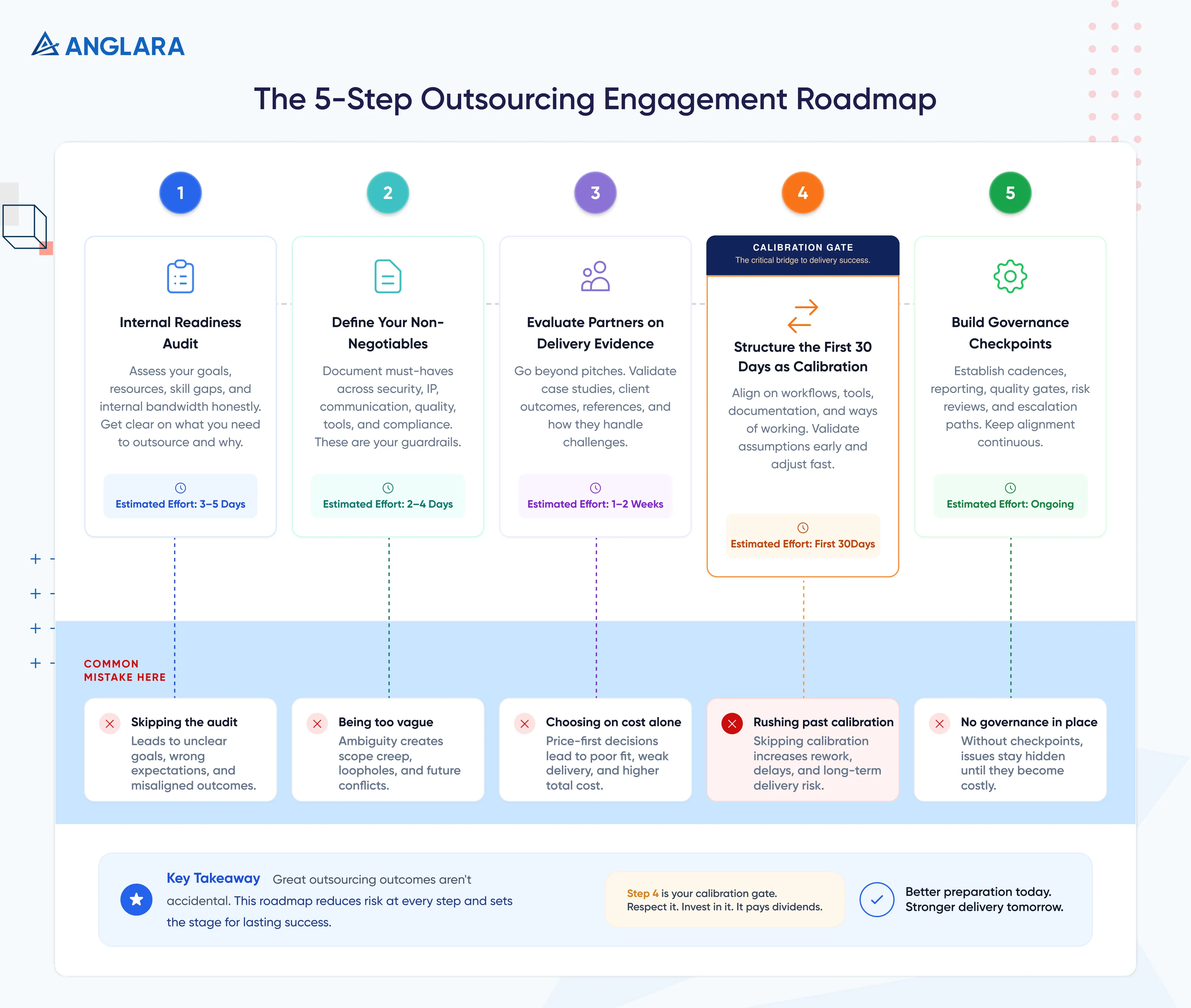
The steps below are sequential for a reason — skipping ahead typically creates rework that costs more than the time you thought you were saving.
Step 1: Audit Your Internal Readiness Before You Shop for a Partner
Before you evaluate a single nearshore software development company or offshore vendor, spend time internally on two questions: what are you actually trying to build, and do you have enough internal clarity to brief an external team effectively?
Vague requirements produce vague delivery — regardless of the model.
This audit should produce a short requirements document, a rough prioritized backlog, and an honest assessment of who internally will manage the relationship.
If your internal product owner is already at 100% capacity, that is a constraint that needs solving before onboarding starts, not after.
Teams that skip this step often find themselves 60 days into an engagement with a capable partner and no clear direction to give them.
Step 2: Define Your Non-Negotiables Before the First Sales Call
Write down the things that are genuinely non-negotiable before you speak with any vendor: timezone overlap requirements, data residency constraints, must-have technical stack experience, compliance certifications, and budget ceiling.
Having these defined in advance keeps vendor conversations focused and prevents you from being talked out of a real requirement by a persuasive sales process.
This list typically also surfaces useful internal disagreements. The CTO may require a specific cloud provider. The RevOps lead may need Salesforce integration. The legal team may require GDPR-compliant data handling documentation.
Getting those voices into the requirement before the search saves significant backtracking later. For projects involving AI software development or complex integrations, these technical non-negotiables often determine which vendors are actually qualified.
Step 3: Evaluate Partners on Delivery Evidence, Not Just Portfolio Design
Most vendor websites look credible. The differentiation is in the delivery evidence behind the portfolio.
Ask for specifics: what did the team actually build on that project, what was the team size, how was the engagement structured, and what went wrong and how was it handled?
A vendor that cannot answer the last question clearly has either not had anything go wrong (unlikely) or is not comfortable being honest about it (more concerning).
For technical due diligence, ask to speak with a senior engineer on the team — not just the sales or account lead. Ask them to walk through a technical decision they made on a recent project and why.
That conversation will tell you more about actual capability than any case study will. Reference checks with previous clients are worth the 20 minutes they take, especially for engagements over $50,000.
Where implementation often breaks: Teams that select a vendor based on lowest cost or most polished pitch deck — rather than on evidence of delivery in a comparable context — tend to discover the mismatch at the worst possible moment: mid-sprint, after technical decisions have already been made.
Vetting is not a bureaucratic step. It is the thing that makes everything else work.
Step 4: Structure the First 30 Days as a Calibration Phase, Not a Delivery Sprint
Even with a well-vetted partner, the first 30 days of an engagement carry elevated risk. Communication norms are still forming. Expectations about response time, code review standards, and documentation depth have not been tested.
Treating this period as a calibration phase — with explicit check-ins and low-stakes deliverables — gives you an early signal about whether the working relationship is going to function well.
A useful structure is a discovery sprint before the first delivery sprint: the external team produces a technical architecture proposal, a breakdown of the backlog into sprint-sized units, and a documented development environment setup.
These outputs are valuable in themselves, but they also reveal how the team thinks, communicates, and documents — which is information you cannot get from a proposal alone.
Step 5: Build Governance Checkpoints Into the Engagement Structure From Day One
Governance sounds heavy. In practice, it usually means a 60-minute monthly review that covers: delivery velocity against plan, any scope changes that have been absorbed informally, documentation status, and any compliance or access control items that need updating.
Most teams skip this because it feels administrative — and then spend significantly more time untangling problems that a monthly review would have caught.
For engagements involving custom mobile app development or web applications with third-party integrations, a governance checkpoint is also the right moment to review API contracts, dependency updates, and any security patches that have been released against libraries in the stack.
Building this habit early creates a team that ships more predictably over a 6–12 month engagement than one that runs purely on sprint velocity.
Costs, Effort, and Timeline
Engagement cost varies significantly based on model, team size, complexity, and geography — but the ranges below reflect typical project archetypes for teams working with offshore or nearshore software development services in 2025–2026.
Actual cost depends on requirements, integrations, data quality, and support expectations.
| Project Type | Estimated Cost (USD) | Timeline |
| Marketing or informational website (WordPress, Tailwind CSS, CMS) | $2,000–$6,000 USD | 6–12 weeks |
| Custom web application or B2B portal (Next.js + Laravel or NestJS backend) | $8,000–$20,000 USD | 3–6 months |
| Mobile application — iOS or Android, standard features (Flutter or React Native) | $9,000–$27,000 USD | 4–7 months |
| AI-assisted feature or workflow automation layer (custom AI development, API integration) | $6,000–$17,000 USD | 2–5 months |
| Full-stack product build with AI, integrations, and ongoing WebOps | $20,000–$56,000+ USD | 6–12 months |
| These are ballpark ranges only — the final cost depends on features, scope, integrations, and support expectations. | ||
Common Mistakes
Most outsourcing problems are not caused by bad vendors. They are caused by avoidable decisions made before the vendor was ever involved.
Treating the Model Decision as a Cost Decision Only
The most common mistake teams make is selecting an offshore or nearshore model purely because it is cheaper — without considering whether the collaboration structure actually fits how their internal team works.
A team with no dedicated product owner, no documented backlog, and sprint ceremonies that routinely get cancelled is not ready for any external delivery model, regardless of price.
The better framing is fit, not cost. Ask whether your internal team has the capacity and structure to manage an external partner effectively.
If the honest answer is no, the right first investment is internal process clarity — not an outsourcing contract. A vendor can only deliver against what you can define and review.
Underspecifying the Backlog and Expecting the Vendor to Fill the Gaps
Handing an offshore development team a three-page brief and expecting a production-ready application in 90 days is a setup for disappointment — not because the team is incapable, but because ambiguity compounds across time zones.
Every assumption that is not made explicit in writing will eventually be interpreted differently by the external team than you intended.
The mitigation is not a 200-page specification document. It is a prioritized backlog with acceptance criteria on the top 10–15 items, clear definitions of done, and an agreed process for handling scope questions as they arise.
For teams building progressive web applications or multi-integration portals, the integration behavior and edge cases are especially worth specifying before sprint one.
Conflating Low Cost With Low Risk
A vendor quoting 40% below the market rate is not a bargain — it is a signal worth investigating.
The most common explanations are: the team is more junior than advertised, the quote excludes items that will appear as change requests, or the vendor is under-resourcing the project and planning to supplement with contractors mid-engagement.
None of these scenarios are guaranteed, but they are common enough that an unusually low quote should trigger more due diligence, not less. Ask for a breakdown of the quote by role and rate.
Ask what happens if a senior engineer on the team leaves. Ask how the vendor handles scope change pricing. The answers will tell you whether the number is sustainable or aspirational.
Skipping the Pilot or Discovery Phase to Save Time
The pressure to move fast is real. But teams that skip a structured discovery or pilot phase to accelerate delivery almost always spend more time later unwinding architectural decisions that were made too quickly.
A two-to-four-week discovery sprint — where the external team produces a technical architecture document, API mapping, and a sprint breakdown — costs a fraction of the rework it prevents.
This is especially true for engagements involving third-party API integrations, data migrations, or AI features.
The unknowns in those domains tend to be significant, and they surface fastest when you give a capable team a short, focused window to investigate before committing to a full delivery schedule.
Think of the discovery phase not as a delay — but as the investment that makes the delivery estimate credible.
What to Prepare for Your First Call
A little prep makes the first conversation far more useful. Have these ready:
- Your current workflow and the specific pain point you want to solve
- The systems it must integrate with (CRM, ERP, payments, data sources)
- A rough budget range and a target timeline
- One success metric that would make the project worth it
- Who on your side will own decisions and feedback
Key Takeaways
- The offshore vs nearshore vs onshore decision should be driven by collaboration fit and project type — not by cost alone. Rate optimization without process fit often produces higher total cost.
- Nearshore development teams typically offer the best balance for US and EU clients who need real-time sprint collaboration and cost efficiency — usually five or more hours of daily timezone overlap.
- Offshore development is well-matched to clearly scoped, asynchronous-friendly work. It underperforms in high-ambiguity, fast-iteration projects where daily synchronous decisions are required.
- Hidden costs — management overhead, rework from ambiguity, knowledge transfer, compliance gaps in development environments — routinely add 20–35% to offshore budgets that did not account for them.
- IP assignment clauses, data residency requirements, and governing law provisions should be reviewed by legal counsel before any contract is signed — not treated as boilerplate.
- A two-to-four week discovery phase at the start of any engagement is not a delay — it is the investment that makes the delivery estimate credible and the architecture defensible.
- Hybrid delivery structures — strategic and client-facing work near or onshore, execution work offshore — often outperform any single model for mid-market teams with a capable internal product anchor.
- Quality in offshore and nearshore delivery is primarily a function of process clarity and communication structure, not geography. The same team will produce very different output depending on how the engagement is managed.
Frequently Asked Questions
What is the typical cost difference between offshore, nearshore, and onshore development?
Offshore development — particularly from India, Eastern Europe, or Southeast Asia — typically runs 40–65% less than equivalent onshore rates in the US or UK. Nearshore teams, particularly in Latin America or Central Europe, usually fall somewhere in between, running 25–45% below US onshore rates while offering better timezone overlap. Onshore rates in the US for senior engineers often start at $150–$200 per hour for agency or contractor work. The actual cost difference on a full project depends on team composition, project complexity, and how much management overhead the engagement requires — hidden costs like knowledge transfer, rework, and communication friction can close the gap significantly if they are not planned for.
How much does timezone difference actually matter in practice?
Timezone difference matters most on projects with high ambiguity, fast iteration cycles, or frequent stakeholder input. For a US team working with an offshore team in India — a 9–12 hour gap — meaningful real-time collaboration is limited to an hour or two per day at best, which creates a natural asynchronous rhythm. That works well for clearly scoped execution work but adds latency to decisions that would otherwise take a five-minute Slack call. Nearshore teams in overlapping or adjacent timezones — typically three to five hours apart — allow for live standups, real-time reviews, and same-day feedback loops, which makes them better suited to iterative, fast-moving product work. The practical test is asking how many synchronous decisions your project needs per week and whether your current process can absorb a 24-hour decision lag.
Is the quality of offshore development lower than nearshore or onshore?
Not inherently. Offshore development quality varies significantly by vendor, team composition, and engagement structure — just as it does with any delivery model. India, for example, has a deep pool of highly experienced engineers in frameworks like Laravel, NestJS, and Next.js, as well as significant AI and cloud infrastructure expertise. The quality risk with offshore delivery is not geography — it is ambiguity. Offshore teams working with poorly defined requirements, no feedback loops, and no governance checkpoints will produce lower-quality output than the same team working with clear specifications and weekly structured reviews. Quality is a function of process and communication as much as talent.
How do I choose between offshore and nearshore software development for my project?
Start with your collaboration requirements, not your budget. If your project needs daily real-time interaction, fast feedback loops, and close alignment with a product owner who is active during business hours, a nearshore development team is usually the more practical fit. If your project is well-specified, has a clear backlog, and can operate asynchronously with well-structured handoffs, offshore delivery often provides better cost efficiency without a meaningful quality tradeoff. Compliance requirements matter too — if your project involves EU personal data or regulated healthcare information, confirm that any offshore vendor can demonstrate compliant data handling practices before the engagement begins. When in doubt, a short paid discovery sprint with a shortlisted vendor will tell you more than any proposal comparison will.
Is Anglara an offshore, nearshore, or onshore company — and how does that affect working with you?
Anglara is an India-based digital solutions company serving clients in the US, UK, EU, and Australia — which places us in the offshore category by geography. In practice, we structure engagements to work within our clients' collaboration preferences: we use async-first documentation, scheduled overlap windows for real-time sprints, and clear escalation paths so that timezone distance does not create decision latency. Our team has delivered projects across AI development, web and mobile applications, and B2B portals for clients in healthcare, travel, arts, and technology sectors. If you want to understand how a working engagement with Anglara would be structured for your specific project, the most direct answer comes from a 30-minute consultation rather than a generalized description.
What are nearshore software development companies, and how are they different from offshore vendors?
Nearshore software development companies are outsourcing firms located in countries that share a similar or adjacent timezone to their primary client base. For US companies, typical nearshore locations include Mexico, Colombia, Argentina, and Brazil. For Western European companies, Eastern European countries like Poland, Romania, and Ukraine are common nearshore markets. The defining characteristic is timezone proximity — usually within three to five hours — which enables real-time collaboration that pure offshore arrangements in Asia or South Asia cannot easily replicate. Nearshore vendors tend to cost more than offshore alternatives but less than domestic onshore options, positioning them as a middle-ground model for teams that need both cost efficiency and collaborative flexibility.
What should I check before signing a contract with an offshore or nearshore development team?
The most important items to verify before signing are: IP ownership — confirm the contract includes an explicit IP assignment clause in your favor, not just a work-for-hire assumption; data handling — ask how the team manages access to any personal or sensitive data in development and staging environments; governing law — confirm which jurisdiction's law governs the agreement and where disputes would be resolved; team composition stability — ask what happens if a key engineer leaves during the engagement; and exit terms — understand what data, code, and documentation you receive if the engagement ends early. Reference checks with one or two previous clients are worth the time investment on any engagement above $30,000.
Can a hybrid delivery model work for a small or mid-market team?
Yes, and it is often the most practical structure for teams that have some work requiring close client-facing collaboration and other work that is better suited to asynchronous execution. A common hybrid pattern is keeping product management, UX, and stakeholder communication onshore or nearshore, while routing backend development, QA, or data engineering work to an offshore team. The challenge with hybrid models is coordination overhead — maintaining coherent delivery across two or more locations requires clear documentation standards, shared tooling, and someone responsible for integration. For teams with a capable internal tech lead or product owner, hybrid delivery can outperform any single-model approach. For teams without that internal anchor, it can create confusion rather than efficiency.
How long does it typically take to onboard an offshore or nearshore development team?
Meaningful productivity from an offshore or nearshore team typically takes four to eight weeks from the first day of engagement — not from the contract signing date. The first two weeks usually cover environment setup, codebase familiarization, tooling access, and initial backlog refinement. Weeks three and four are typically a calibration sprint where the team ships low-risk deliverables and both sides establish communication norms and quality standards. Full velocity — where the external team is operating as efficiently as they will on a stable sprint cadence — usually appears around week six to eight. Teams that expect full output from day one tend to misread early-sprint velocity as a capability signal when it is actually an onboarding reality.
What is a realistic timeline for a custom web application built with a nearshore development team?
A custom web application of moderate complexity — for example, a B2B portal with user authentication, a dashboard, third-party API integrations, and a content management layer — typically takes four to six months from discovery to production launch with a nearshore team of three to five engineers. Discovery and architecture take two to four weeks. Core feature development typically runs eight to fourteen weeks across iterative sprints. QA, UAT, and staging refinement usually add three to five weeks. Post-launch stabilization and monitoring adds two to four weeks. Projects with more integrations, regulatory requirements, or evolving scope will take longer. A discovery sprint at the outset is the most reliable way to produce a delivery timeline you can actually plan around.