

Research by McKinsey and the University of Oxford found that large IT projects run on average 45% over budget and deliver 56% less value than predicted.
That number does not surprise most CTOs or product owners who have been through a failed build. It surprises them that so little has changed.
Custom software development is not the risky option. Poorly scoped, poorly staffed custom software development is. Done with the right process, it is often the most precise tool available for a business with workflows that packaged software cannot serve.
This guide covers what custom software development actually involves, what it typically costs, where implementations break, and how to evaluate whether it is the right move for your team right now.
Custom software development is the process of designing, building, and deploying software tailored to a specific organization's workflows, data, and users — rather than adapting a business to fit a packaged product.
It is typically used when off-the-shelf tools cannot support a core process, when integration debt between multiple SaaS tools has become a drag on operations, or when a product idea requires a capability that no existing platform offers.
Custom development can include web applications, mobile apps, internal platforms, APIs, and AI-integrated systems. It is not always the right answer — for straightforward use cases with good SaaS coverage, buying is usually faster and cheaper.
But when your competitive advantage lives in a process or data model that generic software was not built for, custom development is often the cleaner long-term path.
Who This Is For
This guide is written for decision-makers evaluating a custom software investment — not developers looking for a framework comparison.
If you are trying to work out whether to build, buy, or extend, and what the realistic tradeoffs are, this is for you.
- CTOs and technical leads at SMBs and mid-market companies whose current stack is generating integration debt or workflow workarounds
- Founders and product owners with a software idea that does not map cleanly to existing SaaS platforms
- CMOs and RevOps leaders whose marketing and sales workflows depend on manual steps that should be automated
- Operations leaders who have outgrown their current tools but are not sure whether a custom build or a platform migration is the right move
When Off-the-Shelf Software Stops Being Enough
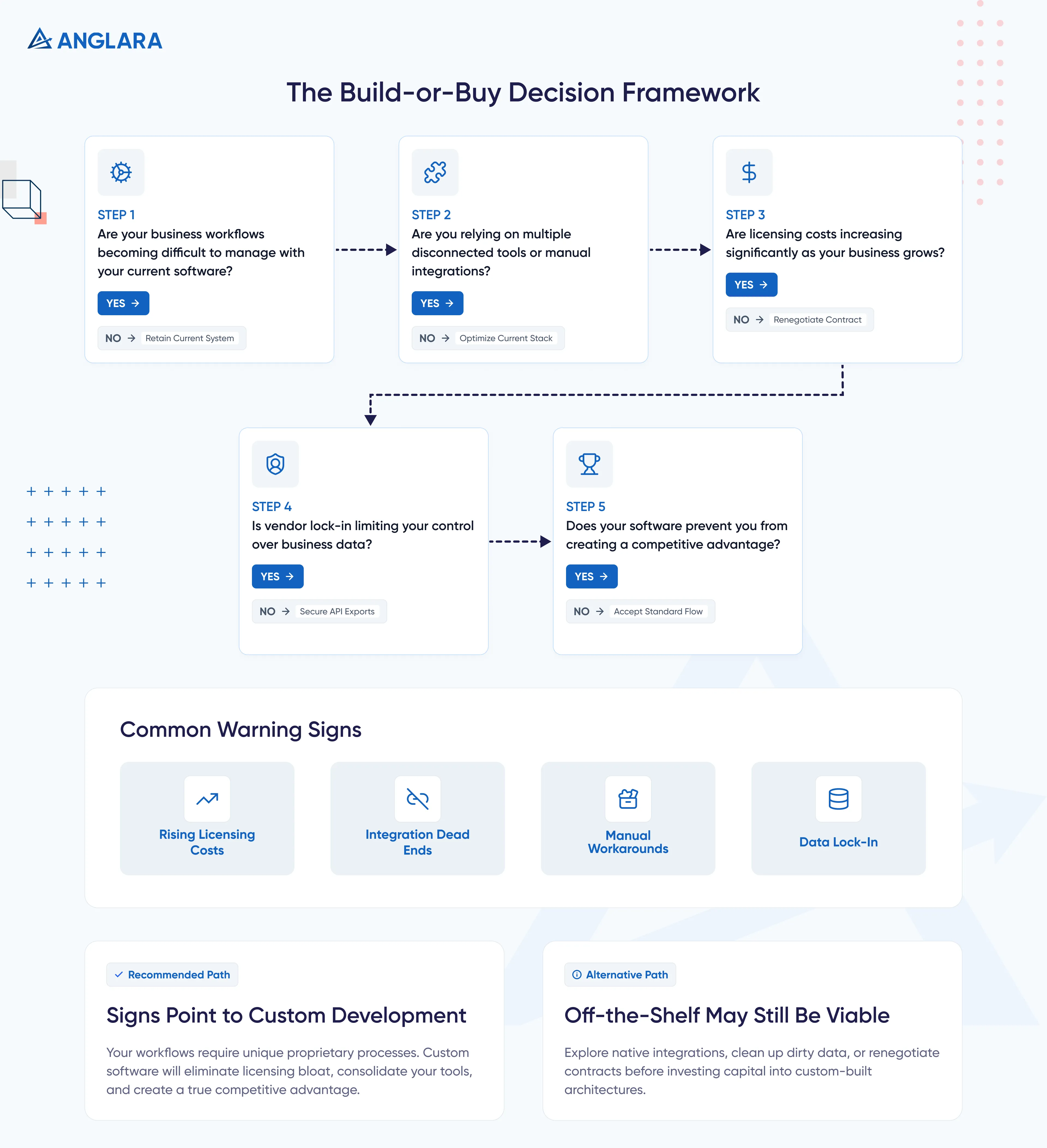
Most teams start with SaaS. That is usually the right call. Packaged software is faster to deploy, cheaper to start, and supported out of the box.
The problem is that SaaS tools are built for the median use case — and the median use case is rarely yours.
Over time, teams build workarounds. They use Zapier to connect tools that should talk natively. They export CSVs manually because the API does not support the data shape they need.
They train staff on software that does not match the way the business actually operates. Each workaround is small. Collectively, they become a meaningful drag on productivity, data quality, and the ability to scale.
The Standish Group's CHAOS Report has consistently found that a significant portion of software projects — custom and packaged alike — fail to deliver expected value.
The difference with custom development is that when scoped and managed correctly, the software can be held accountable to your specific outcome. A packaged product's roadmap belongs to the vendor, not to you.
Custom software development services exist for exactly this inflection point: when the cost of fitting your business to a tool exceeds the cost of building a tool that fits your business.
What Custom Software Development Is and How It Works
Custom software development is the end-to-end process of defining, designing, engineering, and deploying software built specifically for one organization's needs.
Unlike a SaaS subscription, the software is typically owned by the client, built to their data model, and able to be modified without a vendor's permission or pricing tier.
The process usually starts with discovery — translating business requirements into a technical specification — and moves through design, development, testing, deployment, and ongoing maintenance. Each phase produces a deliverable.
A well-run custom development engagement treats those deliverables as checkpoints, not formalities.
Key Components of a Custom Software Build
Most custom software projects involve several technical layers working together. The backend — typically a framework like NestJS, Laravel, or Django — handles business logic, data storage, and API communication.
The frontend — often built with Next.js and styled with Tailwind CSS, whether a web interface or a mobile app — handles what users see and interact with.
APIs connect the new software to existing tools, data sources, or third-party services the business already relies on.
Beyond the core stack, modern custom software development increasingly involves AI and automation layers — workflow triggers, machine learning models, generative AI features, or real-time data processing pipelines. These are not add-ons.
When integrated at the architecture stage rather than bolted on later, they can meaningfully change what the software is capable of.
At Anglara, our custom software development services are structured around this full-stack view from the start of discovery — not after the core build is done.
Types of Custom Software Development
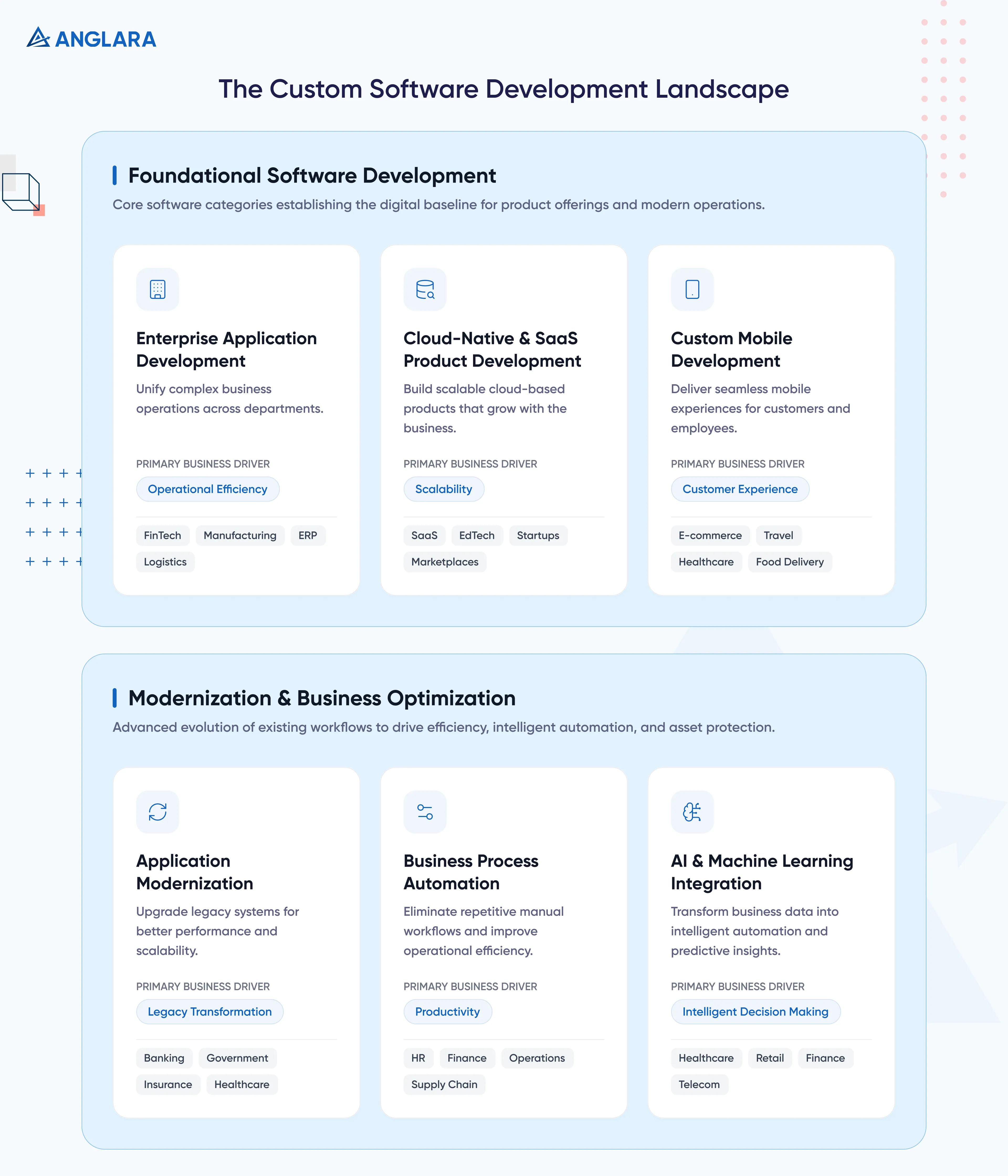
Custom software development is not a single category. The term covers a wide range of build types, each with different scopes, timelines, and cost profiles.
Understanding which type applies to your situation is one of the most important steps before talking to any custom software development agency.
Enterprise Application Development
Enterprise applications are large-scale systems that manage core business operations — ERP, CRM, inventory, HR, or finance platforms built specifically for the organization's data model and compliance requirements.
These are typically chosen over off-the-shelf enterprise software when the business has non-standard workflows, a high volume of transactions, or strict data residency and security requirements that vendor-hosted SaaS cannot satisfy.
Enterprise application builds are usually the longest and most complex category of custom software. They require thorough discovery, phased delivery, and a clear change management plan.
Skipping any of those three typically results in the kind of overrun that McKinsey's research describes.
Application Modernization
Application modernization is the process of replacing or re-architecting legacy software — often systems built 10 to 20 years ago — to improve performance, security, and maintainability without losing the business logic they contain.
It is one of the most common engagements a bespoke software development service handles for mid-market and enterprise clients.
Modernization projects carry a specific risk: the temptation to rewrite everything at once. In practice, phased approaches — where the new system runs alongside the old one during transition — typically produce better outcomes and lower operational risk.
This is sometimes called a strangler fig pattern, and it is often the right default for businesses that cannot afford downtime during migration.
Business Process Automation and RPA
Business process automation (BPA) involves building software that replaces or streamlines manual, repetitive workflows — approval chains, data entry, report generation, invoice processing, and similar tasks.
Robotic process automation (RPA) is a subset of this, using software bots to mimic human interactions with existing interfaces where API access is not available.
The distinction matters because RPA is often a temporary fix — it automates around a broken interface rather than fixing the underlying process. Custom BPA, by contrast, redesigns the workflow itself.
When teams come to Anglara's marketing automation services asking about RPA, we usually start by asking whether the goal is to automate the current process or to redesign it. The answer changes the build significantly.
Cloud-Native and SaaS Product Development
Cloud-native development involves building software designed from the ground up to run on cloud infrastructure — typically on AWS, Google Cloud, or Azure — using microservices, containers, and managed services rather than monolithic architectures.
This approach is common for SaaS products, internal platforms that need to scale elastically, and any system where uptime and global availability are non-negotiable.
For founders building a SaaS product, or for operations teams replacing an on-premise system, cloud-native architecture typically offers better scalability and lower long-term infrastructure cost.
The tradeoff is complexity: cloud-native systems require more architectural planning upfront, and that planning is where many early-stage projects underinvest.
AI and ML Integration
AI integration in custom software can range from adding a generative AI feature — a document summarizer, a chat interface, an intelligent search layer — to building a full machine learning pipeline that ingests data, trains models, and produces predictions that drive business decisions.
For organizations looking to embed intelligence directly into their existing systems, Anglara's work in custom AI development for enterprise workflows covers the full scope from model selection through production deployment.
The gap between those two is significant in terms of cost, data requirements, and time to value.
For most SMBs and mid-market companies, the practical starting point is AI-augmented software: existing workflows made faster or smarter by AI capabilities, rather than AI-first architecture.
Anglara's AI consulting and development services typically begin with workflow mapping before any model selection happens — because the most common mistake is choosing a model before understanding what decision it is supposed to support.
Custom Mobile Application Development
Custom mobile application development covers native iOS and Android apps, as well as cross-platform builds using frameworks like React Native or Flutter.
Teams evaluating scope and technology choices for a mobile-first build can review how Anglara structures its custom mobile app development process, from discovery through post-launch support.
The choice between native and cross-platform typically depends on how performance-critical the app is and how much the experience needs to differ between platforms.
Mobile is often where scope creep is most expensive. Features that seem simple on a desktop interface — real-time notifications, offline mode, camera integration, biometric authentication — each carry meaningful additional complexity on mobile.
A well-scoped custom mobile application development project defines these features explicitly in discovery, with clear decisions about which are in scope for v1 and which are post-launch.
Industry-Specific Software: Healthcare, Fintech, and Edtech
Healthcare, fintech, and edtech are the three verticals where custom software most often makes sense over packaged alternatives — because compliance requirements, data sensitivity, and workflow specificity typically exceed what general-purpose tools can handle.
Healthcare software must navigate HIPAA or NHS data standards. Fintech platforms carry PCI-DSS and local regulatory obligations. Edtech products need to handle FERPA, student data privacy, and often accessibility standards like WCAG.
Building for these verticals is not just a technical challenge — it is a compliance architecture challenge. The regulatory layer needs to be part of the design from day one, not retrofitted after the first audit.
Any custom software development agency working in these verticals should be able to demonstrate fluency in the relevant compliance frameworks before a line of code is written.
In regulated industries where AI needs to meet both functional and compliance requirements simultaneously, Anglara's AI software development services for complex integrations are designed to handle that dual constraint from the architecture phase.
Real Use Cases and Examples
The strongest custom software implementations share one characteristic: clarity on the problem before clarity on the solution. Here are three real projects from Anglara's delivery work.
Travel and E-commerce: Replatforming a Legacy OTA Without Downtime
A travel OTA was operating on Magento — a platform that had served the business well in its earlier stage but was now creating real problems.
The UX patterns were dated, performance had hit a ceiling, and checkout friction was measurably affecting conversion. The business needed to modernize, but it could not afford downtime during migration. Any gap in service would mean lost bookings.
Anglara engineered a custom e-commerce portal using a Laravel backend and Nuxt.js frontend, chosen for performance and long-term maintainability. Critically, the legacy Magento store was kept running in parallel throughout the migration.
This dual-run approach meant buyers experienced no disruption while the new platform was built, tested, and validated. The result was a smooth, zero-downtime replatform that delivered a modern booking experience without any operational risk to the business.
Healthcare: Building an AI Security Layer to Stop Threats in Real Time
A multi-facility healthcare provider was struggling with fragmented security signals spread across multiple tools. Threat detection was slow because no single system had a coherent view of what was happening across endpoints, firewalls, EHR access logs, and identity systems.
Traditional rules-based security tools were missing lateral movement patterns and privilege escalation attempts — exactly the behaviors that precede serious breaches.
Anglara built an AI-assisted security layer that ingested telemetry from all of those sources simultaneously and flagged risky behavior in real time. When a threat was detected, automated playbooks isolated compromised devices and revoked tokens within minutes — not hours.
The system stopped an attack path that would have exposed critical clinical systems and halted operations across multiple facilities, averting estimated losses of up to £10M.
Arts and Entertainment: A Modern Web Presence That Drives Ticket Sales
An improv comedy theatre had a web presence that was not doing its job. Visitors struggled to find show listings, class schedules, and contact details quickly.
Navigation was unclear, content updates required technical intervention, and the overall design did not reflect the quality of what the theatre was offering. The business was losing potential ticket buyers at the point of first contact.
Anglara built the site end-to-end: information architecture first, then UX design, then responsive development — with a content management layer that allowed the theatre team to update shows and classes without developer support.
The result was a high-performance site with a 90+ performance score, improved audience experience, and a measurable increase in ticket sales following launch.
See how we did it. You can also read the verified client review on Clutch.
What Custom Software Development Typically Costs
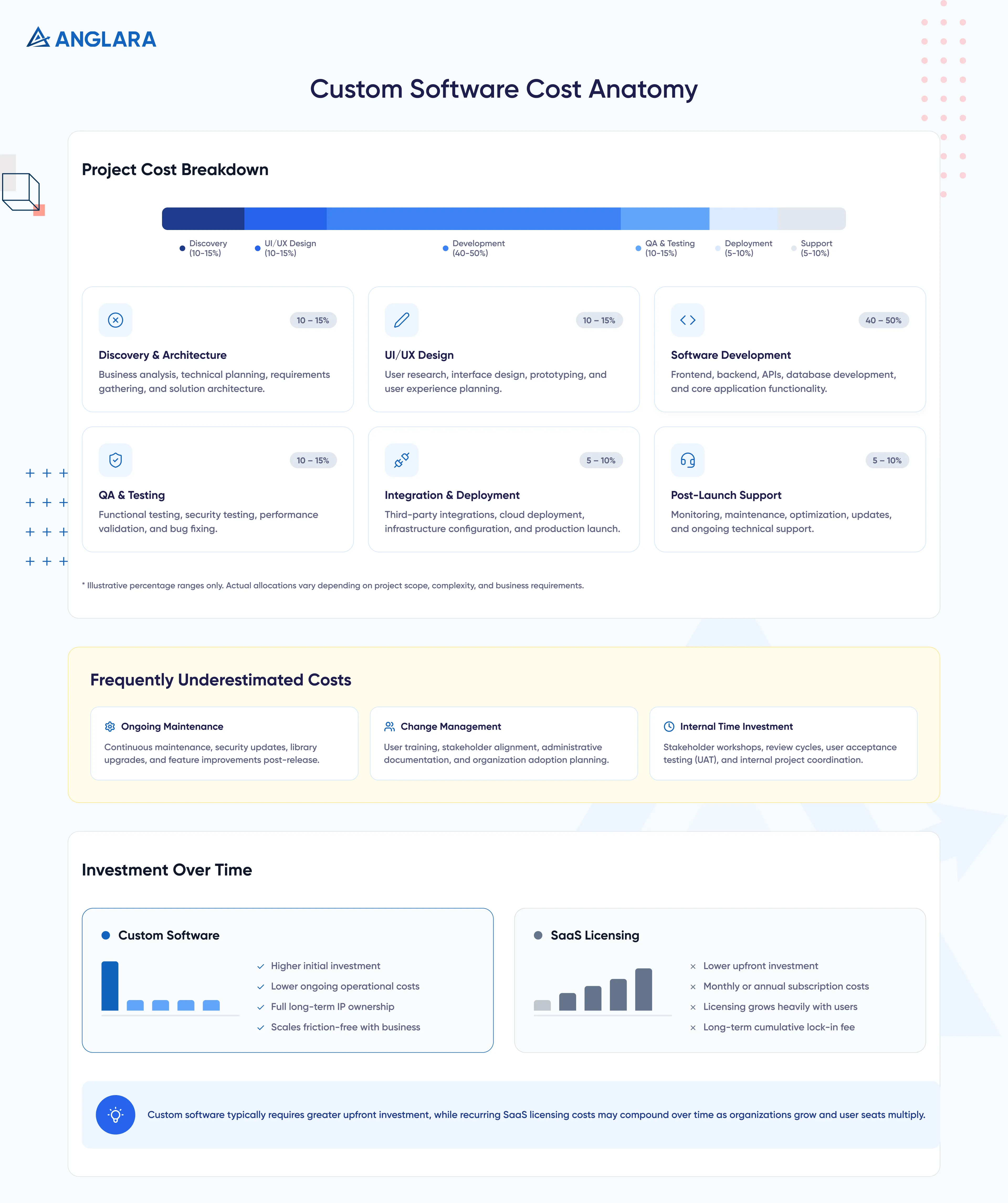
Cost ranges vary significantly by project type, complexity, team location, and whether AI or compliance layers are involved. The figures below reflect typical market ranges for well-scoped projects with a reputable custom software development agency.
Poorly scoped projects can exceed these ranges substantially — McKinsey's research found large IT projects run on average 45% over budget, which is why scoping quality is the most important cost control available.
How to Choose a Custom Software Development Agency
Choosing a custom software development agency is not primarily a technical decision — it is a process and communication decision. The agency's ability to write clean code matters.
Their ability to scope clearly, flag risk early, and maintain momentum when requirements shift matters more.
Questions to Ask Before Signing Anything
The quality of an agency's questions tells you more than the quality of their proposal. A good custom software development agency will want to understand your current workflow before they discuss technology.
They will ask about integrations, compliance requirements, internal technical capability, and what success looks like in month six — not just at launch.
Ask them to walk you through a project that went wrong and what they did about it. Ask how they handle scope changes mid-build.
Ask who will be your day-to-day point of contact and whether that person is also involved in technical decisions. The answers to those questions reveal the agency's delivery culture — which is what actually determines outcomes.
Red Flags to Watch For
A proposal that arrives within 24 hours of the initial call, without a discovery phase, is a proposal built on assumptions. Assumptions are expensive.
Similarly, agencies that resist fixed-scope phases in favor of purely open-ended retainers — without clear deliverable milestones — typically make it harder to hold the engagement accountable.
Watch for agencies that propose technology first and ask about your workflow second. Watch for teams that cannot explain their QA process, their deployment pipeline, or what happens to your codebase if the engagement ends.
And be cautious of any agency that cannot give you a reference from a project in a similar domain or of similar complexity to yours.
How a Custom Software Project Typically Unfolds
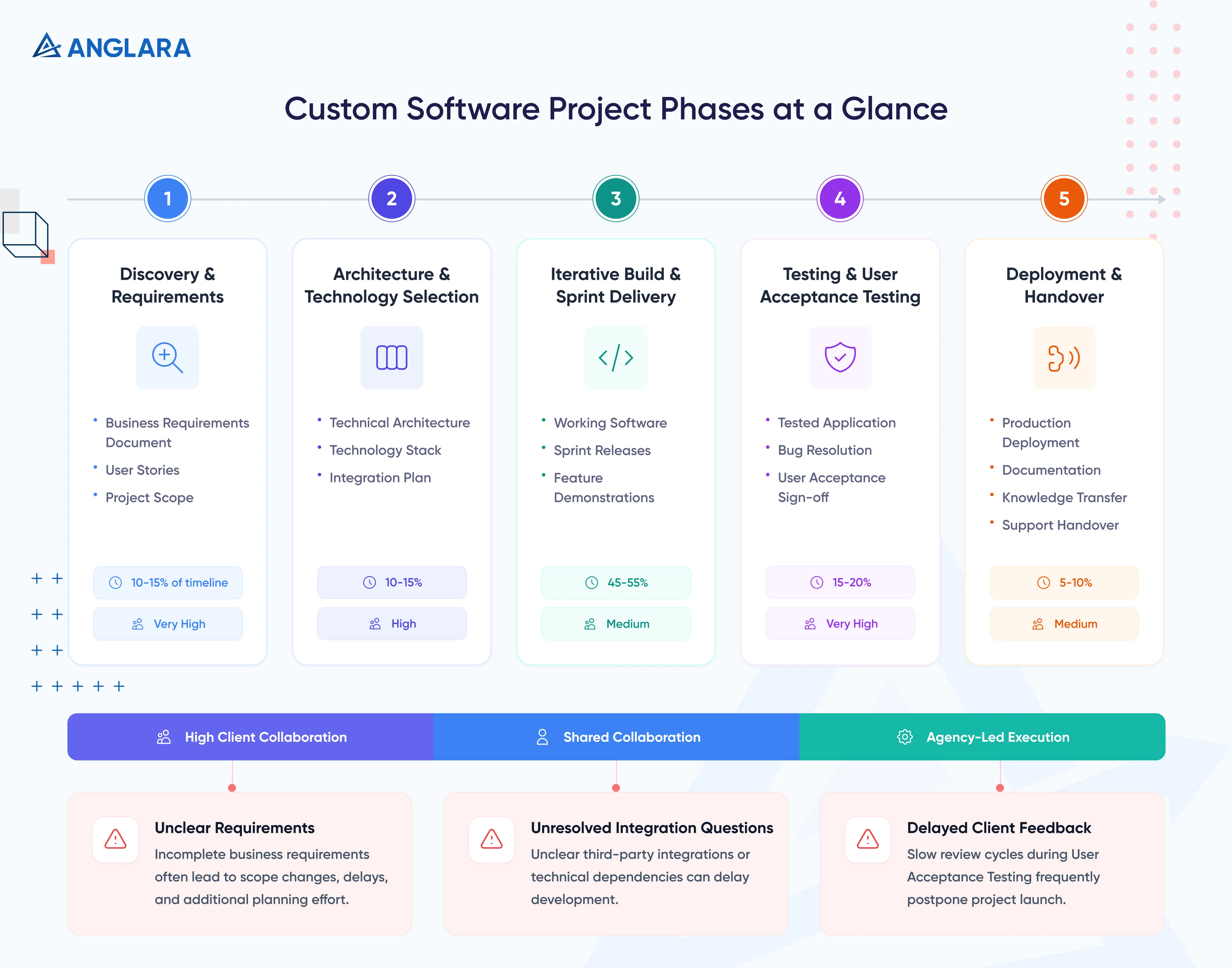
Understanding the standard phases of a custom software development engagement helps you evaluate agency proposals, set internal expectations, and spot when a timeline is unrealistically compressed.
The phases below reflect how well-run projects typically progress — not how every agency chooses to label them.
Phase by Phase: From Brief to Deployment
Discovery and scoping usually takes two to four weeks for a well-defined project. It produces a technical specification, a project plan, and a defined scope.
This is where the cost estimate becomes reliable — before discovery, any number you receive is an educated guess.
Design follows, covering both UX (how users interact with the system) and technical architecture (how the system is built).
Development is typically delivered in sprints of one to two weeks, with working software demonstrated at the end of each sprint rather than at the end of the project.
Testing — unit, integration, and user acceptance — runs throughout, not as a single final phase.
Deployment and post-launch stabilization usually takes two to four weeks after the first live release. Ongoing maintenance, feature development, and performance monitoring follow. Projects that treat deployment as the finish line tend to experience the sharpest post-launch problems.
Not Sure Whether to Build or Buy?
If you are at the point where you are seriously evaluating a custom build, a 30-minute conversation is usually enough to clarify whether it is the right move and what a realistic scope looks like.
Book a free consultation with Anglara — no pitch, no obligation. We typically spend the first half of the call understanding your workflow and the second half giving you an honest assessment of options.
When Custom Software Development Is Not the Right Answer
A credible custom software development guide has to be honest about this: custom development is not always the correct choice.
If your use case is well-served by an existing SaaS platform, building custom will almost certainly cost more and take longer than buying, at least in the first 12 to 18 months.
For startups in the validation stage, the right move is usually to prove demand with available tools before investing in a custom build.
For teams that do not have internal technical capacity to maintain a codebase over time, the ongoing cost of custom software is often underestimated.
Custom development makes most sense when: the workflow is genuinely unique to your business; compliance or data requirements rule out third-party hosting; the long-term cost of SaaS licensing and integration debt exceeds the build investment; or the software itself is the product.
Outside those conditions, buying is usually the more pragmatic choice — and any software development company that tells you otherwise without asking those questions first is not giving you sound advice.
What to Prepare for Your First Call
Whether you are speaking with Anglara or any other custom software development agency, coming to the first conversation with these items ready will make that call significantly more productive — and the estimates you receive significantly more accurate.
- A plain-English description of the problem you are trying to solve — not the solution you have in mind
- A list of the tools and systems your software will need to connect to or replace
- A sense of who will use the software and how often — internal team, customers, or both
- Any compliance, data residency, or security requirements relevant to your industry or geography
- A rough sense of your budget range — even a broad bracket helps scope a realistic proposal
- A decision-making timeline: when do you need this live, and who signs off on the engagement
- Any previous attempts to solve this problem — what was tried, what worked, what did not
Ready to Scope Your Custom Software Project?
Custom software development is a significant investment. Getting the scoping right at the start is the most important thing you can do to protect that investment.
At Anglara, we work with SMBs and mid-market teams across the US, UK, EU, and Australia to scope, design, and deliver custom software that fits the way their business actually operates — not the way a SaaS vendor assumes it does.
If you are evaluating a build and want a clear-eyed view of what it would involve, what it would cost, and whether it is the right move, we offer a free 30-minute consultation. No pitch. No pressure.
Just a practical conversation.
Benefits and Business Outcomes
Custom software delivers value in ways that generic tools rarely can — but only when the build is grounded in real operational problems, not feature wishlists.
Process Speed: From Hours to Minutes on Routine Work
When a workflow is purpose-built for your team's actual steps, the friction that slows down generic software disappears. Approvals that previously required email chains can route automatically.
Data that once needed manual re-entry across three systems can move through a single pipeline. The aggregate time saving across a team of 20 or 30 people often compounds faster than most leaders expect.
In practice, teams that automate document-heavy or approval-driven processes with custom tooling typically reduce task completion time by a significant margin — not because the technology is faster per se, but because the unnecessary steps are simply removed.
The comparison is less about raw speed and more about eliminating the workarounds that accumulate when off-the-shelf tools don't quite fit.
Reduced Error Rates and Manual Rework
A large share of errors in business operations trace back to manual data entry, copy-paste between systems, or staff interpreting unclear process steps differently.
Custom software can eliminate all three by enforcing validation at the point of input, syncing data automatically across connected systems, and presenting each user with only the fields and actions relevant to their role.
This matters especially in regulated industries. A healthcare provider handling patient data across multiple facilities, for example, faces real compliance and safety risk when records are manually reconciled.
Purpose-built logic — with audit trails, access controls, and automated checks — reduces that exposure in ways that a generic SaaS product with broad defaults cannot replicate cleanly.
Long-Term Cost Structure: Ownership vs. Perpetual Licensing
Subscription costs for SaaS tools are easy to justify at small scale.
At mid-market scale, they can become a significant and growing line item — especially when you're paying per seat, per module, or per API call across several platforms that don't fully integrate.
Custom software typically involves a higher upfront investment but shifts the cost model toward maintenance and iteration rather than recurring license fees.
According to a Deloitte study on technology spend, organizations that consolidate fragmented tooling into purpose-built platforms often find that total cost of ownership over a three-to-five year horizon compares favorably to multi-vendor SaaS stacks.
The break-even point varies by complexity and team size, but for teams with stable, well-defined processes, the economics of ownership frequently favor a build decision.
Risks, Compliance, and Governance
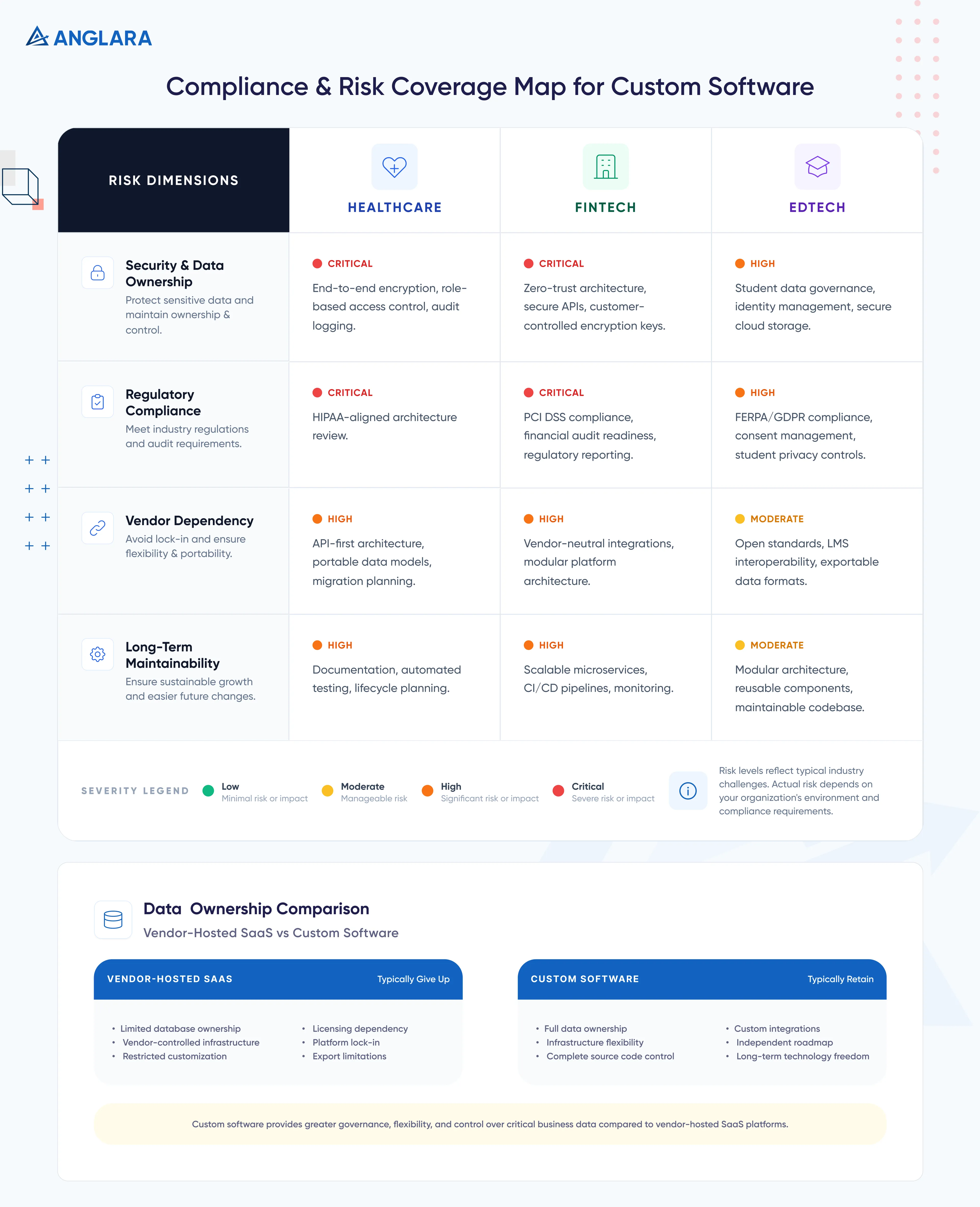
Custom software introduces capabilities that off-the-shelf tools don't — and responsibilities that off-the-shelf vendors normally carry for you.
Security and Data Ownership
When you build custom software, you own the codebase — and that means you own the security posture too. SaaS vendors maintain infrastructure security as part of their offering.
With custom software, penetration testing, dependency patching, and vulnerability scanning become your team's responsibility, or your agency's, depending on your support agreement.
This is manageable, but it requires planning. Teams that treat security as a post-launch concern typically discover gaps at the worst moment.
The right approach is to define your security requirements before development begins — including data residency rules, encryption standards, access control models, and your plan for ongoing patching. For organizations in regulated industries, this is not optional.
OWASP's Application Security Verification Standard provides a practical framework for setting those requirements early.
Regulatory Compliance in Specialized Industries
Healthcare, fintech, and edtech each carry sector-specific compliance obligations that must be designed into the system architecture — not bolted on afterward.
HIPAA in the US, GDPR across the EU and UK, and PCI-DSS for payment processing are the most commonly cited, but there are often additional regional or sector-specific requirements layered on top.
The challenge is that compliance requirements affect database design, logging behavior, user consent flows, third-party integrations, and data retention policies — all decisions made early in the build.
An agency that treats compliance as a checklist at the end of a project is a red flag. It should be a constraint that shapes the architecture from day one.
Ask specifically how your agency handles compliance scoping during the discovery phase, and request evidence of prior work in your sector.
Vendor Dependency and Long-Term Maintainability
One of the quieter risks in custom software is what happens when the original development team is no longer available.
If documentation is thin, the codebase is tightly coupled, or proprietary frameworks were used without good reason, a future team — internal or external — will struggle to maintain and extend the system.
This is sometimes called 'key person risk' at the agency level.
Mitigation starts with contractual clarity: you should own the source code, have access to all repositories, and receive handover documentation as part of the project scope. Insist on standard, well-supported technology choices.
Open-source frameworks with large communities — Laravel, React, Flutter, and similar — are preferable to niche or custom-built solutions that no other developer would recognize.
The Linux Foundation's research on open-source sustainability is useful background for understanding why technology standardization matters at the governance level.
What Teams Usually Underestimate
Compliance scoping and security architecture are almost always underestimated in time and cost — particularly when a team is eager to get into the build phase.
In our experience, the conversations that feel slow early (data residency, access control models, audit log requirements) are the ones that prevent expensive rework six months later. Slowing down during discovery is usually the fastest path to a clean launch.
Implementation Roadmap
The steps below are sequential for a reason — skipping or compressing early phases is the most common cause of rework, scope creep, and delayed launches.
Step 1: Discovery and Requirements Definition
Before any code is written, the team needs a clear picture of the problem being solved, the users affected, the systems involved, and the constraints in play.
Discovery typically involves stakeholder interviews, process mapping, a review of existing tools, and an audit of data sources and integration requirements. This phase surfaces the assumptions that would otherwise become expensive mid-project surprises.
A good discovery phase produces a requirements document, a prioritized feature list, and an agreed definition of what 'done' looks like for the first release.
It also surfaces the questions that haven't been asked yet — which is often its most valuable output. Discovery usually takes two to four weeks, depending on organizational complexity. Rushing it to save time almost always costs more time later.
Step 2: Architecture and Technology Selection
Once requirements are clear, the engineering team designs the system architecture — how data flows, how components interact, which services are built versus integrated, and what the deployment environment looks like.
Technology choices are made here: frontend framework, backend language, database type, cloud provider, authentication approach, and API strategy.
This is also where scalability decisions are made. A system built for 500 users per month behaves differently from one built for 50,000. Getting the architecture wrong at this stage is expensive to fix later.
The output of this phase is typically a technical specification or architecture diagram that the development team works from — and that your internal team can review and question before a line of code is committed.
Step 3: Iterative Build and Sprint Delivery
Development typically proceeds in two-week sprints, with each sprint delivering a working, testable increment of the system. Agile delivery allows the team to respond to feedback and clarify requirements as they become concrete — something that waterfall delivery struggles with.
Stakeholders should be involved in sprint reviews, not just at milestones.
This phase is where scope management becomes critical. Every 'small addition' has a development cost.
A product owner who maintains a disciplined backlog — separating must-haves from nice-to-haves — will typically deliver a better product on a shorter timeline than one who approves every new idea as it surfaces.
The team building your custom mobile app or web platform should be transparent about the sprint plan and any scope changes in writing.
Step 4: Testing, Security Review, and UAT
Quality assurance is not a single event at the end of a project. Unit tests, integration tests, and end-to-end tests should be running continuously throughout the build.
Before launch, a formal user acceptance testing (UAT) phase gives your internal team the opportunity to validate that the system behaves as expected against real workflows — not just test cases written by developers.
Security review should happen here too, not as an afterthought. For any system handling sensitive data, a penetration test or code security audit before launch is strongly advisable. Performance testing under realistic load conditions is also part of this phase.
Teams that skip or compress testing to hit a launch date almost always face the consequences in production — often at the most inconvenient possible moment.
Step 5: Deployment, Handover, and Ongoing Support
A well-planned deployment is staged, not a single switch flip. Blue-green deployments or canary releases allow new code to be rolled out incrementally, with the ability to roll back quickly if something goes wrong.
Your agency should provide a deployment runbook, monitoring setup, and a defined on-call plan for the period immediately after launch.
Handover documentation — including codebase structure, environment setup, API documentation, and admin guides — should be delivered as part of the project, not treated as an optional extra.
Post-launch support arrangements vary: some teams bring development in-house, others retain their agency for ongoing iteration. Either way, the transition should be planned in advance.
Discovering that your team can't maintain the system on the day your agency contract ends is a governance failure, not a technical one.
Common Mistakes
Most custom software projects that run over time and over budget share a small set of avoidable mistakes — usually made in the first few weeks.
Treating the First Release as the Final Product
One of the most common and costly mistakes is specifying everything upfront as if the first version needs to be complete.
This leads to bloated scope, long build cycles, and a product that reaches users many months after the business problem first appeared. By then, requirements have often shifted.
A more effective approach is to define a tightly scoped first release — often called an MVP — that solves the core problem for the primary user group. Subsequent iterations can add complexity once the team has real usage data.
Teams that launch fast and iterate tend to end up with better products than those that try to perfect before launch.
Underinvesting in Discovery and Requirements
Pressure to start building quickly is understandable, but discovery is not a delay — it is the work that makes the build efficient.
Teams that skip or rush requirements definition consistently experience mid-project scope changes, missed integrations, and architecture decisions that have to be revisited. Each of those events costs more time than the discovery phase would have taken.
A two-to-four week discovery engagement with your agency is a small investment relative to a six-month build. It surfaces disagreements early, aligns stakeholders on priorities, and gives the development team the clarity they need to estimate accurately.
If an agency proposes going straight to build without a discovery phase, treat that as a signal worth questioning.
Choosing a Vendor on Price Alone
The lowest quoted price for a custom software project is rarely the lowest total cost. Agencies that win on price often do so by underestimating scope at proposal stage, using junior developers unsupervised, or skipping documentation and testing.
The costs of those shortcuts appear during the build or after launch — usually at a moment when the timeline and budget have no room left.
Evaluating agencies on communication quality, technical depth in discovery conversations, transparency about process, and evidence of delivered work in similar contexts will typically produce better outcomes than a price-led shortlist.
Verified third-party reviews — such as those on Clutch — are a useful signal when assessing an agency's actual delivery record.
No Clear Owner on the Client Side
Custom software projects require active client participation.
Decisions about features, priorities, user flows, and integrations come up constantly during a build — and when there is no single accountable person on the client side to make those calls, the project stalls.
Development teams waiting for approvals lose momentum and billing continues.
Before a project starts, identify a product owner or project lead on your side who has the authority to make decisions, the time to review sprint output regularly, and the access to gather internal feedback quickly.
This role is not decorative. On projects where client-side ownership is strong, agencies consistently report smoother delivery and fewer surprises at launch.
Key Takeaways
- Custom software is the right choice when your competitive advantage lives in the process — not just the product category. If the workflow is generic, buy. If it is core, build.
- Discovery is not overhead — it is the work that prevents expensive rework. A two-to-four week discovery phase consistently saves more time than it costs.
- Security and compliance requirements must shape the architecture from day one. Retrofitting them after launch is significantly more expensive than designing for them upfront.
- The total cost of ownership over three to five years often favors custom software over fragmented multi-vendor SaaS stacks for teams with stable, well-defined workflows.
- A strong client-side product owner with decision-making authority is as important to project success as the quality of the development team. Absent ownership stalls builds.
- Launch a tightly scoped first release. Real usage data will make your second release significantly better than a longer initial build aimed at completeness.
- Always confirm code ownership, documentation standards, and technology choices contractually before the build begins — not after.
- Vendor selection based on delivery evidence in your sector — verified through case studies and third-party review platforms — produces better outcomes than price-led shortlisting.
Frequently Asked Questions
How long does custom software development typically take?
Timeline depends heavily on project scope and complexity. A focused internal tool or dashboard can often be delivered in two to four months. A customer-facing web application with third-party integrations typically takes four to seven months. Enterprise platforms or AI-integrated systems commonly require eight to eighteen months from discovery to stable production release. The discovery and architecture phases at the start of a project are the most important factor in keeping delivery on schedule — teams that rush them typically extend total project time rather than reduce it.
How much does custom software development cost?
Costs vary significantly based on scope, team location, and integration complexity. Broadly, internal workflow tools tend to range from $25,000 to $60,000 USD, customer-facing web applications from $60,000 to $150,000, and enterprise platforms with AI components from $150,000 upward. Ongoing maintenance and hosting costs should also be factored into the total cost of ownership. According to Clutch's 2024 data, most mid-market custom projects fall between $50,000 and $250,000 for the initial build. The clearest way to get an accurate estimate is a scoped discovery engagement before committing to a full build.
How do I decide whether to build custom software or buy an off-the-shelf solution?
Start by asking whether your competitive advantage is tied to the process the software would support. If a SaaS tool covers 80% of your needs at reasonable cost and the remaining 20% is not business-critical, buying is usually the faster and lower-risk choice. If the workflow is core to your differentiation, if you're paying for features you don't use while missing ones you need, or if you're maintaining a growing number of workarounds to make a tool fit — those are signals that a custom build may be justified. The decision also depends on scale: the economics of ownership often favor custom software over multi-vendor SaaS stacks for teams with stable, well-defined processes at mid-market scale.
What does the custom software development process look like?
A well-run custom software project typically follows five phases: discovery and requirements definition, architecture and technology selection, iterative build in two-week sprints, testing and user acceptance, and deployment with handover documentation. Discovery — which involves stakeholder interviews, process mapping, and integration audits — is the phase most often underinvested and most responsible for project overruns when skipped. Agile delivery during the build phase allows the team to respond to feedback and refine requirements as they become concrete, which produces better outcomes than fixed-scope waterfall approaches for most project types.
Should I use a custom software development agency or hire freelancers?
For projects with clear scope and a short delivery window, a skilled freelancer can be effective. For anything involving multiple roles — frontend, backend, QA, architecture, project management — an agency typically delivers more reliably because it provides team continuity, process structure, and accountability. Agencies also carry institutional knowledge across projects that individual freelancers rarely replicate. The key is evaluating any agency on their delivery record in your sector, their discovery process, and their documentation standards — not just their rate card. Verified third-party reviews on platforms like Clutch are a useful independent signal.
What is the difference between custom software development and bespoke software development?
The terms are used interchangeably in most markets. 'Bespoke software development' is more common in UK and European contexts, while 'custom software development' tends to be the preferred term in the US and globally. Both refer to software designed and built specifically for a single organization's requirements, as opposed to off-the-shelf or SaaS products built for a broad user base. The distinction that matters operationally is not the label — it is whether the software is architected around your specific workflows, data structures, and integration requirements from the ground up.
What technologies are most commonly used for custom software development?
Technology choices should follow requirements, not the other way around. That said, widely adopted choices for backend development include Laravel (PHP), Node.js, Python (Django or FastAPI), and Ruby on Rails. For frontend and web applications, React, Next.js, and Nuxt.js are commonly used. Mobile development frequently uses Flutter for cross-platform or native Swift and Kotlin for platform-specific builds. Cloud infrastructure typically runs on AWS, Google Cloud, or Azure. Choosing well-supported, open-source frameworks with large communities is important for long-term maintainability — it ensures future developers can work with the codebase without depending on the original team.
How do I evaluate a custom software development agency before signing a contract?
Look for evidence of delivered work in your industry or project type — case studies, verified reviews, and references from past clients. Assess the quality of their discovery process: do they ask clarifying questions before quoting, or do they send a proposal within 24 hours of your first conversation? Confirm that your agency will hand over full source code ownership and documentation as part of the project scope. Ask specifically how they handle scope changes mid-project and what their testing and QA process looks like. Red flags include vague timelines, no mention of discovery, and pricing that seems significantly lower than comparable agencies without a clear explanation.
Can custom software integrate with our existing tools and systems?
In most cases, yes — integration with existing tools is a standard part of custom software builds. Common integrations include CRMs, ERPs, payment gateways, identity providers, cloud storage, and third-party APIs. The critical step is identifying all required integrations during the discovery phase, not mid-build. Some legacy systems have limited or poorly documented APIs, which can add complexity and cost. Data migration from existing systems also requires careful planning — the quality and structure of your current data often has more impact on integration timeline than the technical complexity of the connection itself.
What ongoing costs should I expect after custom software is launched?
Post-launch costs typically include hosting and infrastructure (cloud server costs, CDN, database hosting), security maintenance (dependency updates, patching, periodic security audits), and development time for bug fixes and feature iterations. Depending on your support arrangement, you may also have a retainer with your development agency for ongoing work. These costs are generally predictable and controllable — unlike SaaS licensing fees, which often increase with seat count or usage. Building a basic maintenance budget into your total cost of ownership calculation before making a build-versus-buy decision gives you a more accurate comparison.