

Think chatbot consulting services are just about picking a bot platform? Think again.
The real win usually comes earlier: choosing the right use case, the right knowledge sources, the right escalation rules, and the right success metrics before anything goes live.
If you get that part right, a chatbot can become a useful business system. If you skip it, you often end up with a flashy demo that frustrates customers and creates more work for your team.
Chatbot consulting services help businesses decide what chatbot to build, where it should live, what data it can access, how it should hand off to humans, and how success will be measured. This matters because most chatbot failures are not caused by the interface alone. They usually come from weak knowledge sources, poor integration choices, unclear ownership, or missing governance. Gartner found that 85% of customer service leaders planned to explore or pilot customer-facing conversational GenAI in 2025, but it also noted that many teams still have outdated or backlogged knowledge content, which directly affects bot quality. (Gartner)
Who This Is For
This guide is for:
- CMOs and RevOps leaders trying to reduce repetitive support or lead-qualification work
- CTOs and product owners evaluating whether to add conversational AI to an existing product or support stack
- Founders who want a practical path from idea to pilot without wasting budget
- Operations leaders exploring internal bots for HR, IT, onboarding, or knowledge access
It is especially useful if your team is already asking questions like:
- Should we use a chatbot for support, sales, or internal ops first?
- Do we need consulting, development, or both?
- How do we avoid hallucinations, broken handoffs, and compliance issues?
- What should success actually look like after launch?
The Problem In Plain Language
Most companies do not struggle because chatbots are unavailable. They struggle because they adopt them in the wrong order.
They buy a tool first. Then they try to figure out use cases, knowledge cleanup, escalation logic, analytics, and ownership later. That is backward.
A better approach is to treat the chatbot like a business workflow with a conversational front end. IBM describes enterprise chatbots as AI-powered systems that automate tasks, answer questions, and support customers or employees by integrating with enterprise data, applications, and workflows. In other words, the bot is only as useful as the systems, rules, and content behind it. (IBM)
This is also why the market has moved beyond “FAQ bot” thinking. The CFPB found that each of the top 10 largest U.S. commercial banks had already deployed chatbots as part of customer service, showing that conversational support is no longer a fringe experiment. (Consumer Financial Protection Bureau)
What Chatbot Consulting Services Actually Include
At a practical level, chatbot consulting services sit between business strategy and technical delivery.
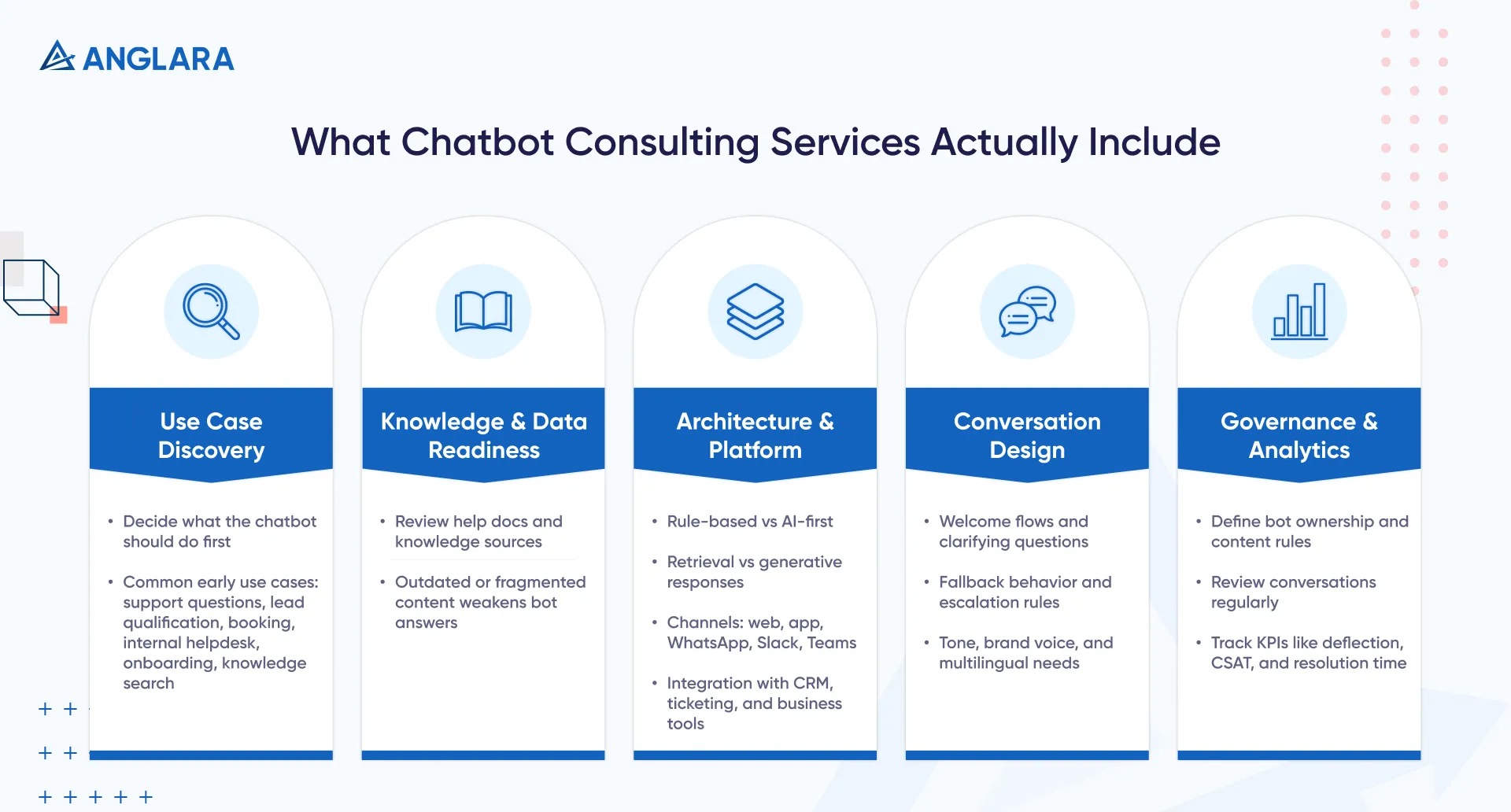
A good consulting engagement usually covers:
Use Case Discovery
This is where you decide what the chatbot should do first. Not everything belongs in a bot.
The strongest early use cases are usually:
- repetitive support questions
- lead qualification
- appointment booking
- internal helpdesk queries
- product onboarding
- knowledge-base search with guided answers
Knowledge And Data Readiness
This is the part many teams underestimate.
If your help docs are outdated, fragmented, or inconsistent, your chatbot will reflect that. Gartner specifically flagged knowledge backlog and outdated content as a major barrier to effective conversational GenAI adoption. (Gartner)
Architecture And Platform Decisions
This is where consulting helps you choose:
- rule-based vs AI-first
- retrieval-based vs generative responses
- web, app, WhatsApp, Slack, Teams, or multi-channel
- hosted SaaS vs more custom architecture
- how the chatbot connects to CRMs, ticketing systems, docs, and business tools
Conversation Design
This includes:
- welcome flows
- fallback behavior
- escalation rules
- tone and brand voice
- multilingual needs
- how the bot asks clarifying questions
- how it avoids overconfident answers
Governance And Analytics
A serious consulting process also defines:
- who owns the bot after launch
- which content can be used
- what the bot must never answer
- how conversations are reviewed
- which KPIs matter: deflection, CSAT, resolution time, booked demos, first-response speed, escalation quality
At Anglara, this is usually where the biggest value sits. Consulting reduces the odds of building the wrong thing fast.
When Chatbot Consulting Services Are A Good Fit And When They Are Not
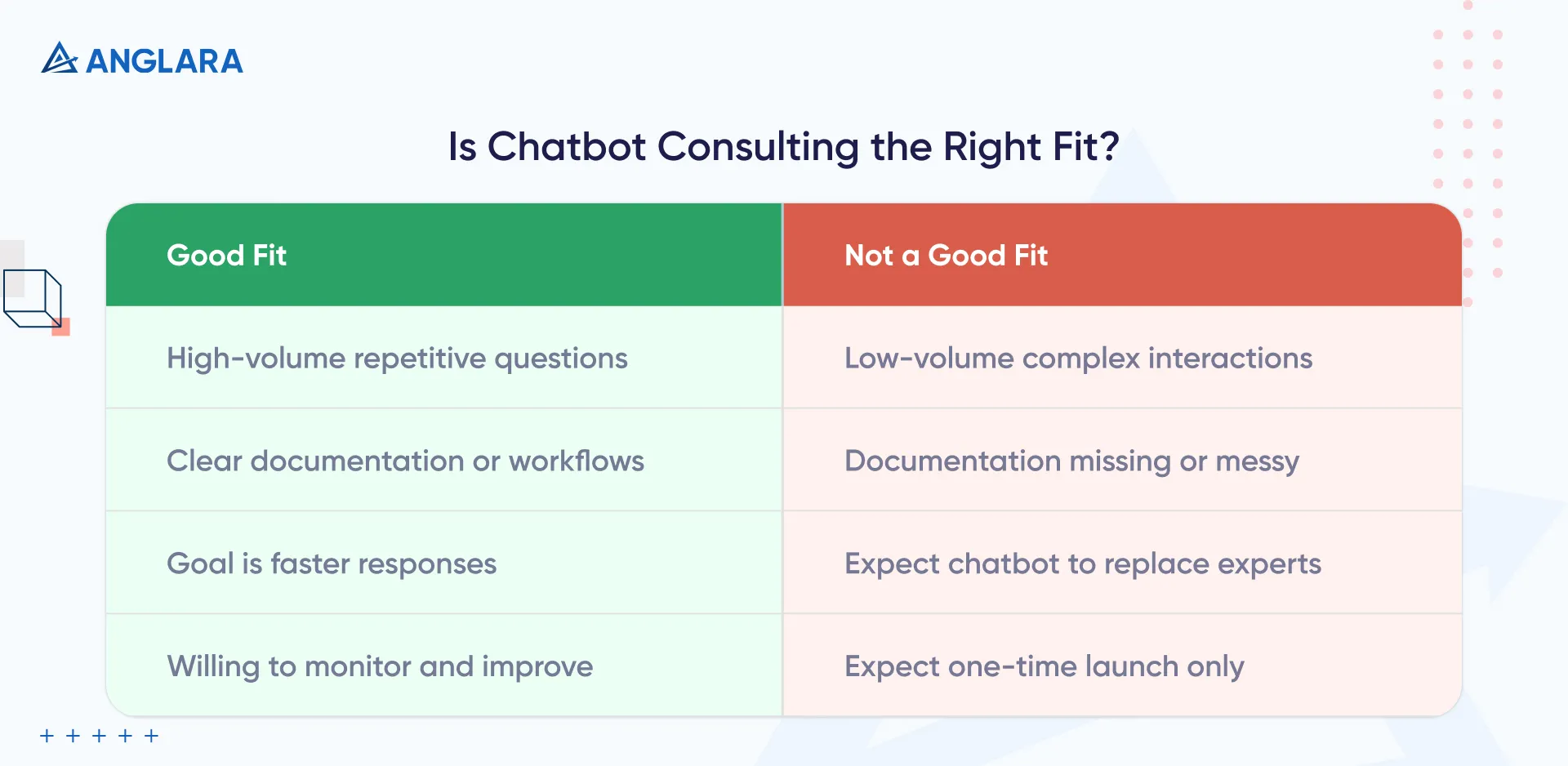
A simple rule: if you need a bot to handle routine work and support people better, consulting makes sense. If you want a chatbot to magically fix broken processes, it usually will not.
Real Use Cases And Examples
Real value shows up when the chatbot is tied to a narrow business job, not a vague ambition.
Customer Service Automation
Klarna’s OpenAI-powered assistant handled 2.3 million conversations in its first month, covering two-thirds of customer service chats. OpenAI says it performed work equivalent to 700 full-time agents, reduced repeat inquiries by 25%, and cut average resolution time from 11 minutes to under 2 minutes. (OpenAI)
That is not just “a chatbot on a website.” That is a clearly scoped service workflow with defined tasks, languages, and outcomes.
Banking And Account Support
Bank of America reported that Erica had surpassed 2.5 billion interactions, with 20 million clients using it to manage finances. The value here is not only self-service volume. It is trust, continuity, and task completion inside a regulated environment. (Bank of America)
Telecom And Complex Issue Resolution
Google Cloud and Verizon said their Gemini-based work led to 95% comprehensive answerability for customer inquiries, while also supporting frontline teams with context-aware help. That is a useful reminder that chatbot consulting is not just about customer-facing chat. It can improve agent support and internal resolution quality too. (PR Newswire)
Internal Knowledge And Operations
IBM highlights employee support, onboarding, IT helpdesk, and data access as major enterprise chatbot use cases, especially when chatbots connect to HR, ERP, CRM, and ticketing platforms. (IBM)
That is why many companies start with an internal bot before rolling out a public one. It is often safer, easier to measure, and faster to improve.
Benefits And Outcomes
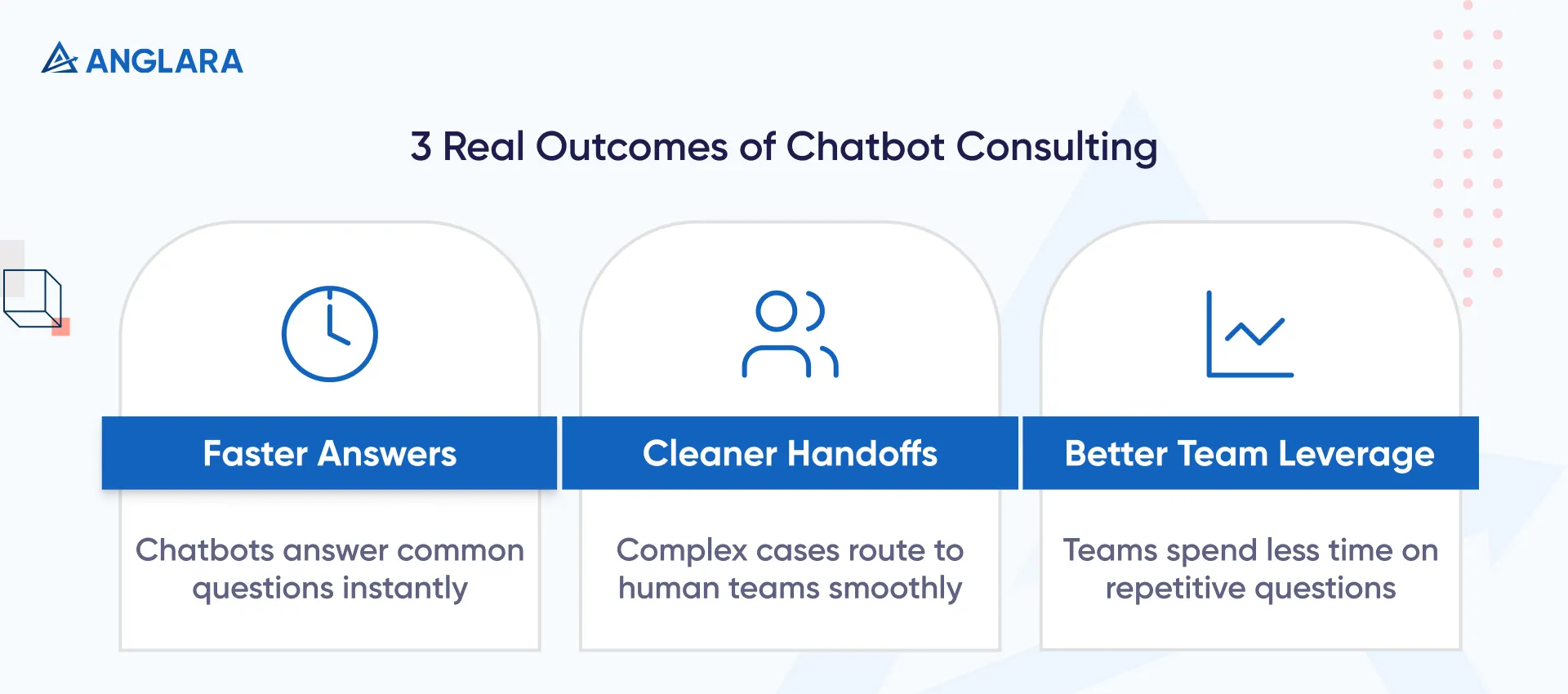
When chatbot consulting services are done well, the upside usually looks like this:
Faster Response And Better Availability
Chatbots can answer around the clock, across regions and time zones, without adding proportional staffing. IBM notes that enterprise chatbots can scale interaction volume without corresponding cost growth. (IBM)
Better Use Of Human Teams
The goal is rarely “remove humans.” The better goal is “move humans to higher-value work.”
Klarna’s case is a good example: the assistant took on routine conversation volume so human effort could move toward more complex queries. (OpenAI)
Cleaner Workflows
A well-planned chatbot can:
- qualify leads before a sales rep joins
- collect booking details before a support agent takes over
- pull account context before escalation
- summarize conversations for faster follow-up
More Consistent Answers
Consistency matters. In regulated or multi-location businesses, variation is expensive. A governed chatbot can standardize how routine questions get answered, while still escalating when confidence is low.
Risks, Compliance, And Governance
This is the section too many service pages underplay.
Chatbots can create value, but they can also create risk when teams skip governance.
Hallucinations And Weak Grounding
Practitioners building knowledge-base bots still complain about made-up pricing, wrong answers, and brittle retrieval if the source content is weak. That is not just a model problem. It is usually a data, prompt, retrieval, or governance problem. (Reddit)
Broken Human Handoff
Another recurring complaint is poor escalation. When the bot hands off without transcript, intent, or context, customers get asked the same questions again. That compounds frustration fast. Reddit discussions around support operations repeatedly point to lost context during handoff as a core pain point. (Reddit)
Trust And Customer Frustration
Deloitte’s banking research notes that chatbots are now common, but many still struggle to earn trust and satisfaction because they feel rigid and fail when the customer needs real resolution. (Deloitte)
Regulatory And Privacy Issues
In sensitive sectors, guardrails matter even more. IBM emphasizes that enterprise chatbots in regulated industries need strong security, data protection, auditability, and compliance alignment. The CFPB also warns that chatbot use in finance affects customer experience in ways institutions need to manage carefully. (IBM)
A strong consulting partner should define:
- what sources the bot can use
- what it should never answer directly
- when it must escalate
- how answers are reviewed
- how permissions and data access are controlled
- how outputs are logged and improved
Implementation Roadmap
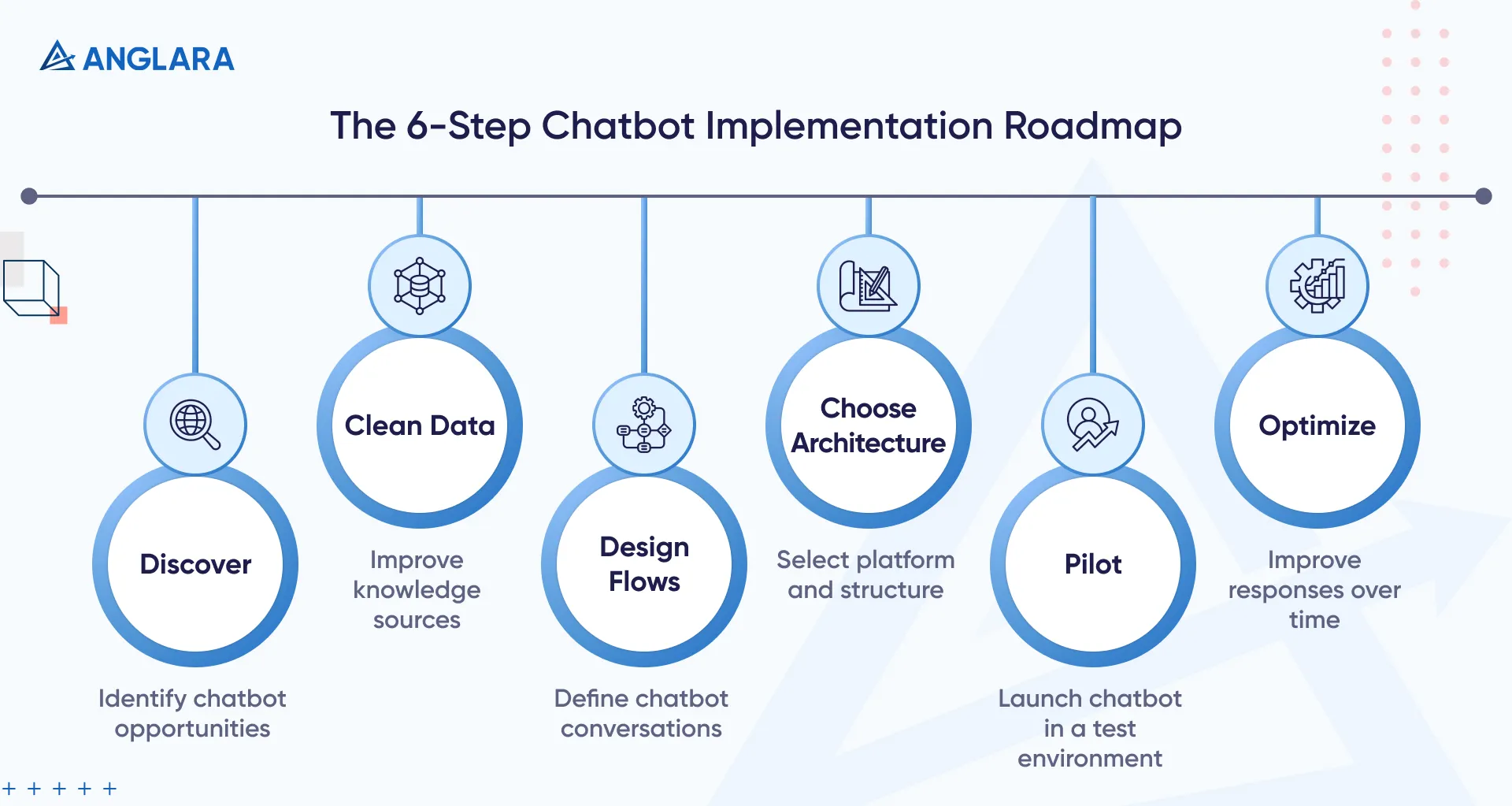
Here is a practical rollout approach that works better than “let’s launch a bot everywhere.”
1. Pick One High-Value Use Case
Start with one measurable job:
- deflect repetitive support tickets
- qualify inbound leads
- help users book demos
- answer internal HR or IT questions
2. Clean And Structure Source Content
Before model tuning, clean the content:
- deduplicate FAQs
- fix outdated articles
- standardize policies
- define source-of-truth systems
- tag restricted content
3. Design The Conversation Logic
Map:
- top intents
- fallback answers
- confidence thresholds
- escalation triggers
- transcript transfer rules
- success metrics
4. Choose The Right Architecture
This is where consulting pays off. Some teams only need a contained website bot with knowledge retrieval. Others need a multi-channel assistant tied to CRM, ticketing, or workflow tools. The architecture should follow the use case, not the other way around.
5. Launch A Controlled Pilot
Start with:
- one team
- one geography
- one product line
- one channel
Measure what really matters:
- containment rate
- resolution quality
- escalation quality
- user satisfaction
- business impact
6. Tune Before Scaling
Look at real transcripts. Fix:
- weak answers
- bad intents
- confusing prompts
- slow replies
- poor handoffs
- edge cases the bot should stop touching
Only then expand to new channels, new use cases, or more automation.
Costs, Effort, And Timeline
There is no universal chatbot price because “chatbot” covers very different scopes.
A simple FAQ assistant is not the same as a multilingual support bot tied to CRM, ticketing, billing, and analytics.
A practical way to frame budget is in three phases:
- consulting / discovery
- pilot build
- rollout and optimization
Market-facing vendor guides vary widely, but they are useful as directional signals. One enterprise guide we reviewed cited roughly $1,500–$5,000 for basic rule-based bots, $7,000–$25,000 for mid-market AI bots, and $50,000+ for complex enterprise deployments. Another vendor frames consulting as a 10-day strategy and discovery workshop before build. Treat those as market signals, not fixed benchmarks. (quickchat.ai)
A practical planning model looks like this:
- Strategy sprint: 1–3 weeks
- Pilot: 4–8 weeks
- Production rollout: 8–16+ weeks depending on integrations, governance, and testing
- Ongoing optimization: monthly or quarterly
What usually drives cost up:
- multiple systems and APIs
- multilingual rollout
- compliance review
- custom actions and workflows
- analytics dashboards
- large or messy knowledge bases
- high-stakes use cases
Common Mistakes
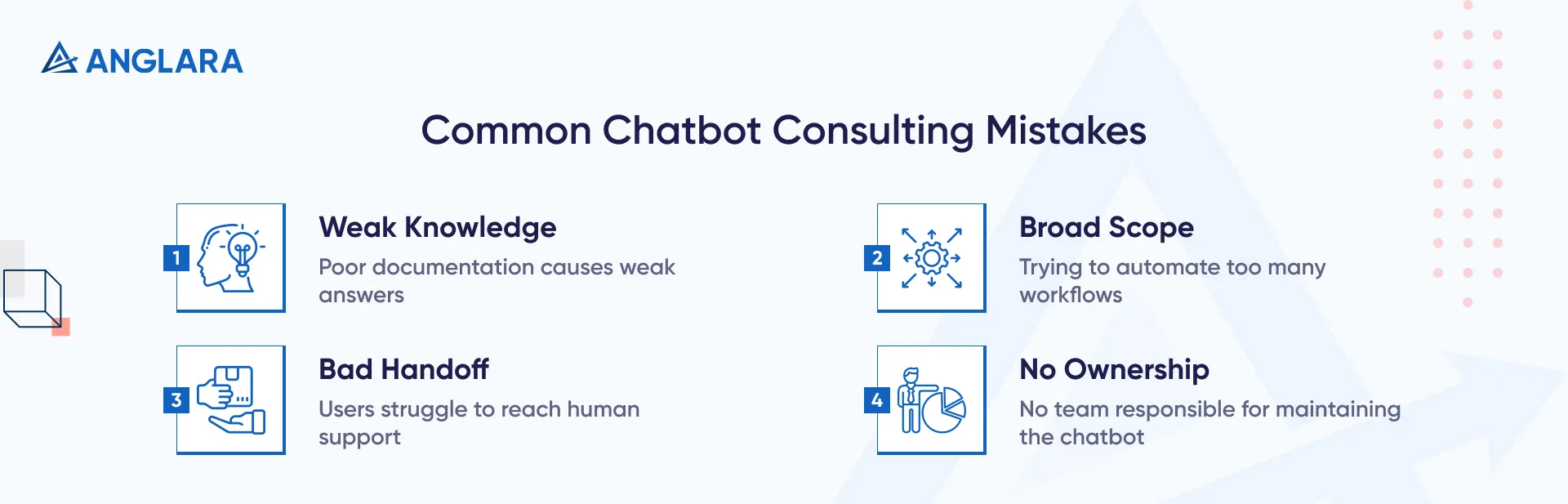
The most common mistakes are surprisingly consistent.
Starting With The Tool, Not The Workflow
A shiny platform is not a strategy.
Letting The Bot Answer Too Broadly
The wider the scope, the more room for errors.
Ignoring Source Quality
If the knowledge base is weak, the bot will be weak.
Measuring The Wrong KPI
A high deflection rate can still hide a bad experience if customers end up needing human cleanup later. Even recent practitioner discussion points to the hidden cost of recovery time when a bot “technically handled” the conversation but created more work downstream. (Reddit)
Treating Handoff As An Afterthought
If the customer has to repeat everything, the experience fails.
Launching Without Ownership
Someone must own content quality, prompt changes, review cycles, and reporting.
FAQs
What do chatbot consulting services include?
They usually include use case discovery, knowledge review, platform and architecture selection, conversation design, escalation logic, integration planning, analytics, and governance setup.
How are chatbot consulting services different from chatbot development?
Consulting helps you decide what to build, why, where it fits, and how to govern it. Development is the actual implementation. Many teams need both, but consulting should come first when the use case or architecture is not yet clear.
Are chatbot consulting services worth it for small businesses?
Yes, if the business has enough repetitive questions, appointment requests, sales qualification, or support workload to justify automation. No, if the business only gets a handful of highly custom queries each week.
How long does it take to launch a chatbot?
A narrow pilot can often launch in a few weeks. A more integrated enterprise chatbot usually takes longer because of data, security, workflow, and testing requirements. The timeline depends more on systems and governance than on UI alone.
How do you reduce hallucinations in a chatbot?
You narrow the scope, clean the source content, use strong retrieval and permissions, define fallback rules, add human escalation, and review live transcripts regularly. In high-risk use cases, the bot should be designed to say “I don’t know” instead of guessing.
What systems should a business chatbot connect to?
That depends on the job. Common integrations include CRM, helpdesk, knowledge base, booking systems, billing tools, ecommerce platforms, Slack, Teams, and internal documentation repositories. IBM specifically highlights deep integration with CRM, ERP, HR, ticketing, and knowledge platforms as a defining trait of enterprise chatbots. (IBM)
What is a good first chatbot use case?
For most teams, the best first use case is repetitive support or internal knowledge access. It is easier to measure, easier to constrain, and easier to improve than trying to build a “universal AI assistant” on day one.
How much do chatbot consulting services cost?
It depends on scope. Expect a discovery phase, then pilot build, then rollout/optimization. Small scoped bots cost far less than enterprise multi-system deployments.
Can a chatbot work for internal teams too?
Yes. IT helpdesk, HR FAQs, onboarding, and knowledge retrieval are strong internal use cases.
Key Takeaways
- Chatbot consulting services are about business design before bot build.
- The best chatbot projects start with one clear workflow, not a broad AI wish list.
- Strong results usually come from clean knowledge, scoped use cases, and good handoff design.
- Governance matters just as much as model choice.
- A pilot-first rollout is safer than an all-at-once launch.
- The right partner should help you choose what not to automate as much as what to automate.
Next Steps
If you are considering chatbot consulting services, do not start by comparing tools alone.
Start by listing:
- your highest-volume repetitive conversations
- your current knowledge sources
- your must-have integrations
- your escalation rules
- your success metrics after 90 days
That will tell you very quickly whether you need a simple support bot, a lead-gen assistant, an internal knowledge bot, or a more custom conversational system.
At Anglara, this is exactly where a short consulting-led discovery can help. You get a clearer use-case roadmap, less rework, and a better shot at launching something your team will actually keep using.
