


AI could transform your business, we’ve all heard that one before. But when you start looking at the numbers, the costs suddenly become confusing.
Is AI development actually affordable, or is this just for tech giants with unlimited budgets?
The truth is somewhere in the middle.
AI development costs range widely, depending on what you're building and how complex you want it to be. But getting this right upfront prevents bad decisions later.
This guide breaks down the actual numbers, so you know exactly where your money goes and how to make smart choices.
Why can AI project costs feel confusing?
Feeling a bit lost? Let us tell you that you're not alone here.
So, if you don't have a machine learning (ML) background, you’re probably frustrated with not knowing clear answers or straightforward price tags. Most business leaders encounter three main obstacles when budgeting for AI:
- Pricing varies wildly across vendors and regions: A chatbot might cost a few thousand from one agency and half a million from another. But there’s surely a why behind that, which you wouldn’t know without digging deeper.
- Hidden costs creep in after work begins: Many AI projects go over budget because the initial estimate covers only “build the model,” not everything that goes with it. Hidden costs surface later in data preparation, integrations, infrastructure, compliance, and ongoing maintenance can add significantly to the original budget if they weren’t properly scoped upfront.
- Comparing apples to apples is hard: Vendors don’t use a standard scale, so the same project can be labeled very differently. What one vendor calls an "intermediate" solution, another calls "advanced” to justify a higher price or make their portfolio look more sophisticated.
In this guide, we focus on business impact and realistic numbers, not technical jargon, because you shouldn’t have to be in the dark about what you're paying for. Here’s what you'll take away:
- Rough budget ranges for different AI project types
- The main factors that drive costs up or down
- Practical ways to reduce spending without sacrificing quality
Let’s get right into it.
AI development cost breakdown by project complexity
The complexity of your AI project determines the price more than almost anything else. Let's break down three tiers so you can see where your needs fall.
Simple AI solutions
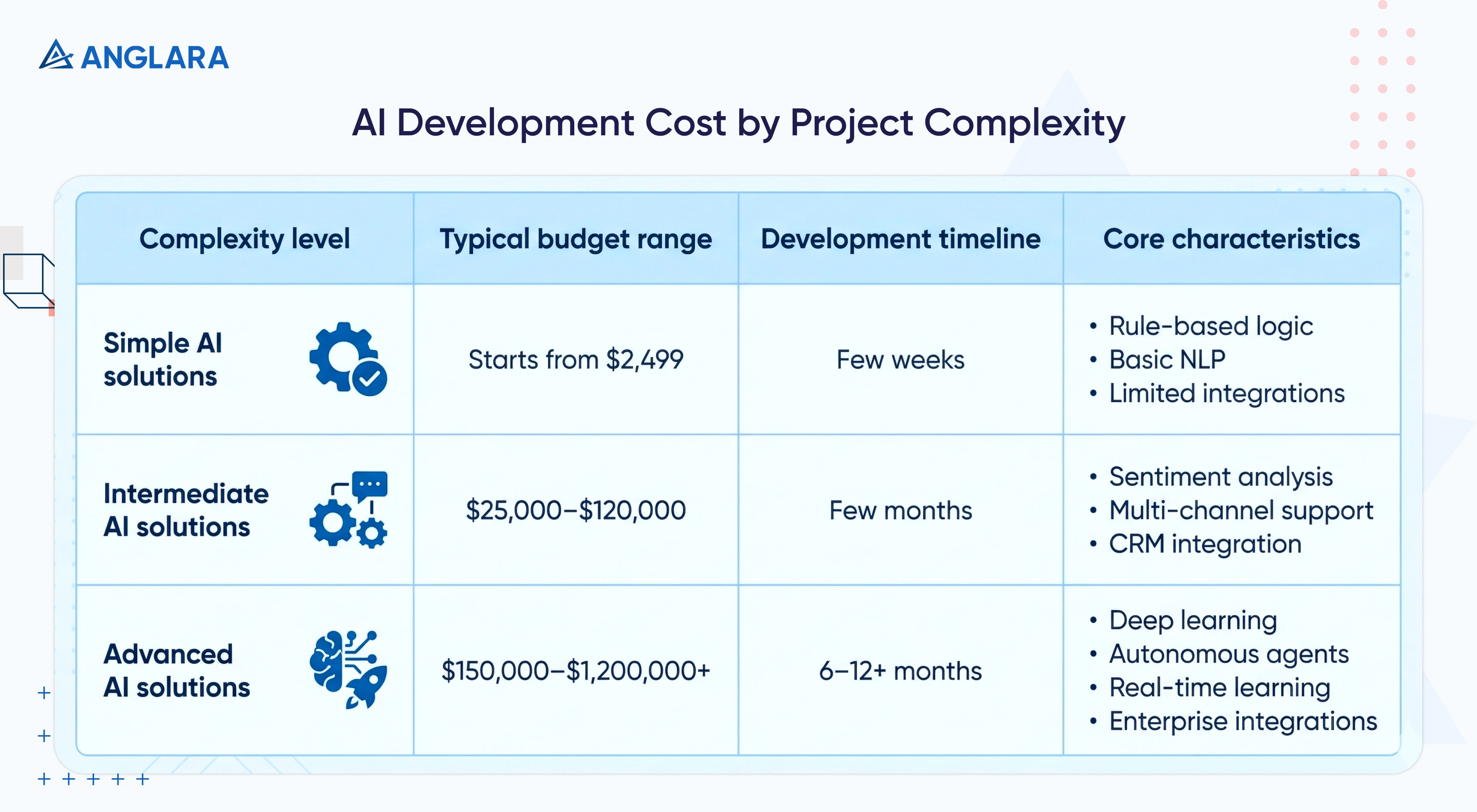
Simple AI solutions are your entry point. Think rule-based chatbots that answer common questions, basic FAQ bots, or simple automation tools that follow set rules. These projects typically start from $2,499.
The development timeline is short, usually within a few weeks. What you typically get includes basic natural language processing (NLP), limited integrations with your existing systems, and a standard user interface.
For example, a financial services company can build a basic chatbot to handle, say, 70% of customer support questions. It may cost them around $10,000 and take 6 weeks, but it will pay for itself in a few months through labor savings.
Intermediate AI solutions
Now let’s take it a step further with intermediate solutions that pack more punch.
These include natural language-powered conversational agents, recommendation engines, and basic ML models. Consider it’s budget for $25,000 to $120,000 and a development timeline of a few months.
At this level, your solution includes sentiment analysis (understanding customer emotion), support across multiple channels such as web and mobile, and integration with your CRM system.
It’s perfect for growing businesses with moderate complexity needs. A good example of an intermediate AI solution is an AI recommendation engine that can analyze browsing and purchase behavior. While the system takes roughly a quarter to roll out, it can deliver about a 15% lift in average order value and significantly increase conversion rates.
Advanced AI solutions
Now let’s talk about the advanced AI solutions. These tackle complex business problems using deep learning, autonomous agents, and predictive analytics platforms. These are the costliest, demanding $150,000 to $1,200,000+, with timelines extending 6 to 12+ months.
While this may sound like a lot, what you get justifies the investment:
- Real-time learning as new data arrives
- Multi-modal AI that handles text and images simultaneously
- Complex enterprise system integration.
Industries like healthcare, finance, and autonomous systems typically operate at this level. For example, platforms like NVIDIA DRIVE process camera, LiDAR, radar, and IMU data together in real time to perceive the environment and integrate with the vehicle’s control stack. It enables continuous learning and updates across fleets.
Key factors that impact AI development cost
Costs don't appear out of nowhere. Several factors determine why two seemingly similar projects have wildly different price tags. Here are six major factors that will determine the cost of your AI software:
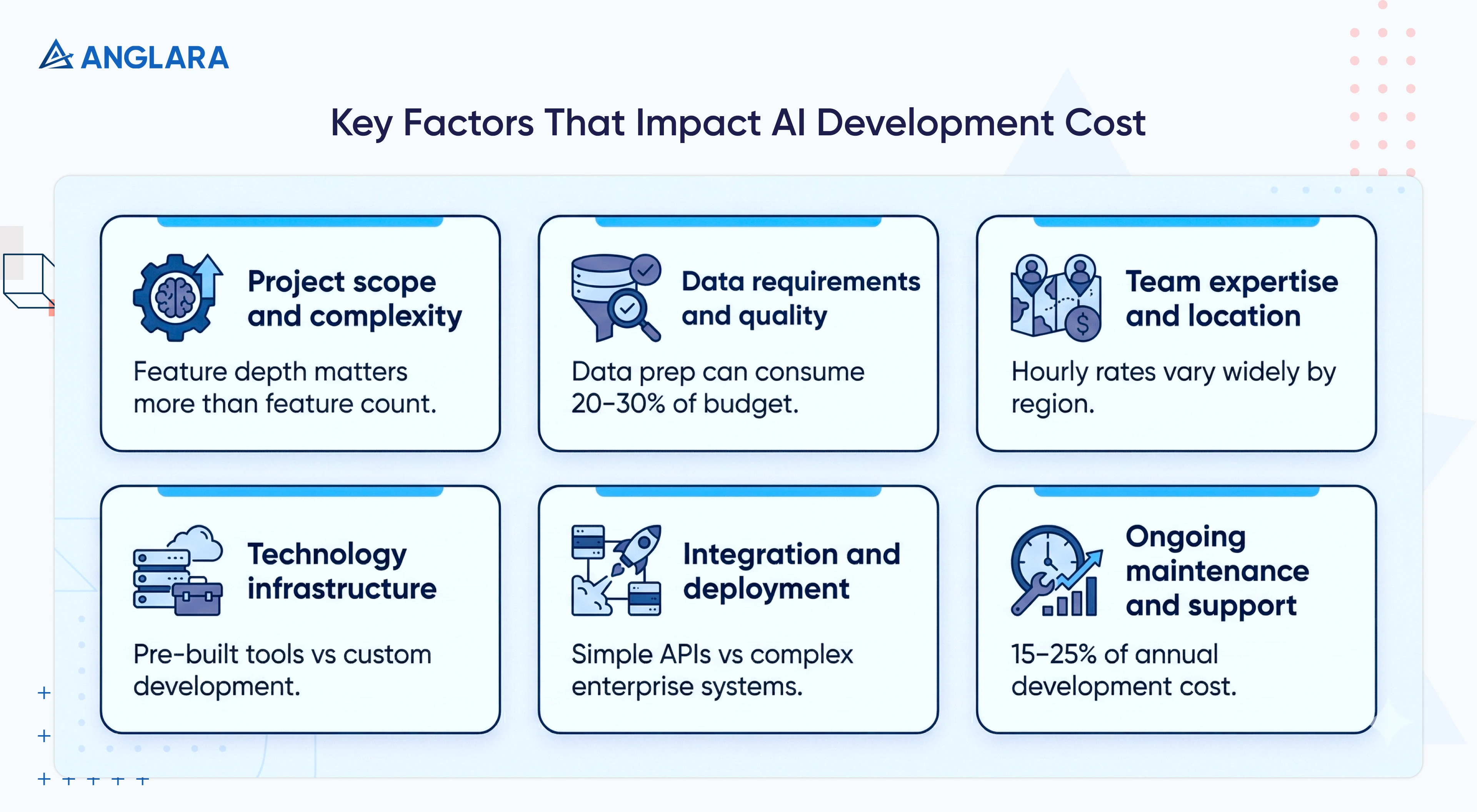
- Project scope and complexity: It’s easy to see that a project with five features costs less than one with twenty. But it’s more confusing when complexity comes in, and it usually matters more than feature count. This is why a chatbot with five well-designed features might be more complex and expensive than a basic tool with ten shallow features.
- Data requirements and quality: Your AI is only as good as the data it runs on. If your data is clean, organized, and labeled, development moves faster and costs less. If data is messy, scattered across old systems, or unlabeled, you'll spend weeks cleaning it up. Data preparation alone can consume 20-30% of your total project budget.
- Team expertise and location: Location dramatically affects cost. For example, in the United States and North America, AI developers charge $100-$250 per hour. In India, the same quality developer would charge an average of under $80 per hour. This is why many multinational companies outsource to India while maintaining domestic oversight.
- Technology infrastructure and tools: The tech stack you choose impacts your budget; however, whether it’s worth it or not is for you to decide. Using pre-built models and open-source frameworks can be cheaper, but they come with limits on customization and control. On the other hand, building everything from scratch may cost more but gives you full control.
- Integration and deployment needs: Simple API integration costs $2,000-$5,000. Complex integrations across multiple enterprise systems can cost more than $30,000.
- Ongoing maintenance and support: Many leaders underestimate the costs of maintaining their AI solutions. Ongoing maintenance typically costs 15-25% of your original development spend annually. For a $100,000 project, budget $15,000 to $25,000 annually for updates, security patches, and model retraining.
AI development cost by solution type
Different AI solutions have different cost profiles. Let's look at the main categories you're likely considering.
AI chatbot and virtual assistant development cost
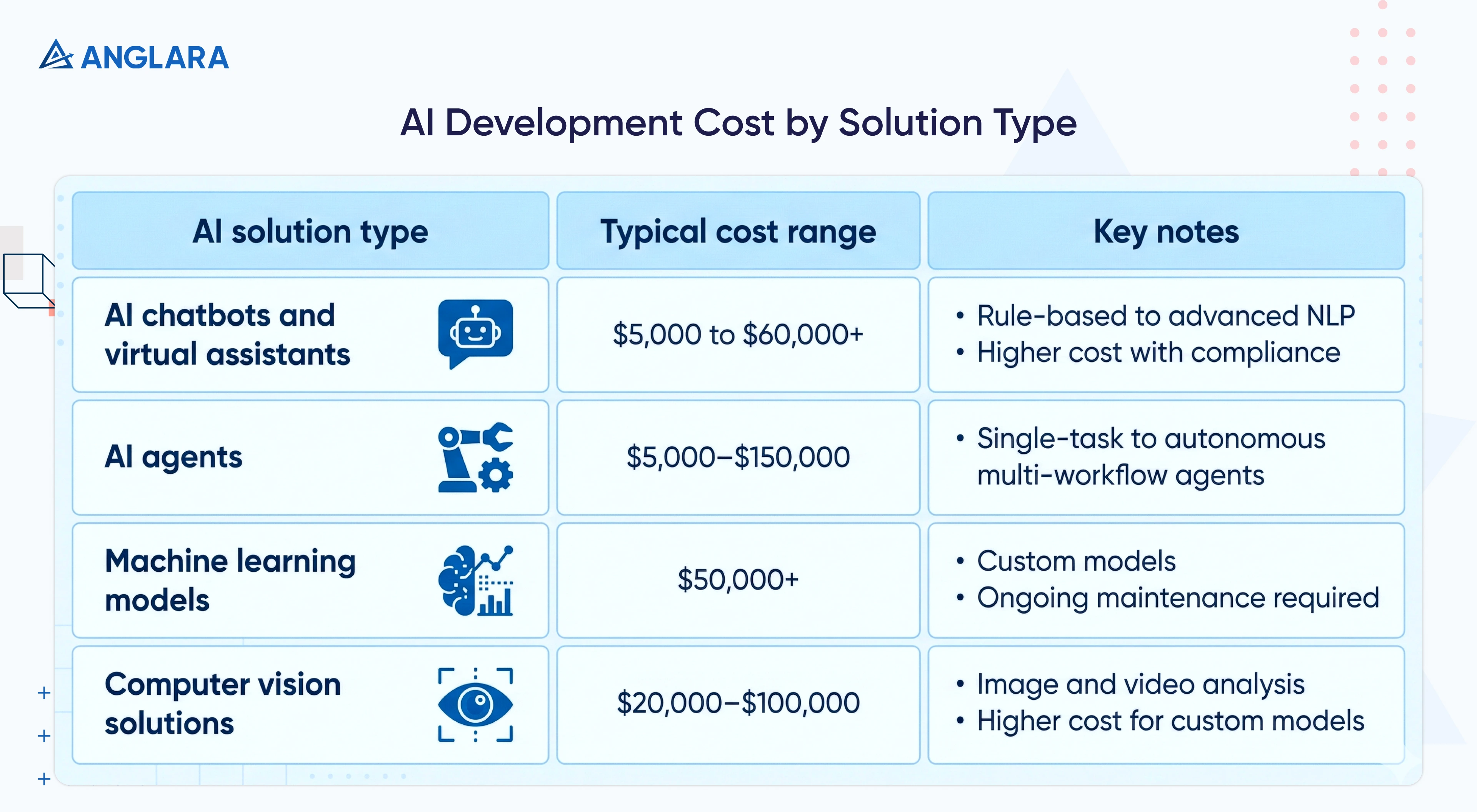
AI chatbot development is popular because chatbots are practical and relatively affordable. Simple solutions start at $5,000 and operate with definite rules, but can’t comprehend context. Advanced solutions can cost more than $60,000, as they demonstrate a wide range of natural language processing and machine learning capabilities.
The breakdown typically looks like this:
- Planning and design ($3,000–$8,000)
- Development and testing ($5,000–$50,000)
- Deployment and integration ($3,000–$7,000).
Certain industrial chatbots may cost more due to compliance and security requirements. For example, a medical chatbot ranges from $120,000 to $350,000, while financial service chatbots need 25-35% more investment.
AI agent development cost
AI agents are autonomous systems that handle complex workflows without constant human input. Since they're more sophisticated than chatbots, AI agent development is priced accordingly:
- Single-task agents handling specific jobs, such as appointment booking, run $5,000 to $15,000
- Multi-task agents managing several related functions cost $20,000 to $50,000
- Autonomous agents planning and executing complex workflows demand $50,000 to $150,000.
The typical AI agent development project takes 8 to 12 weeks. To break it down, the costs often include the following:
- Requirements analysis and planning (up $2,499)
- Data collection and preparation ($5,000–$10,000)
- Model development and training (starts from $20,000)
- Testing and deployment ($5,000–$10,000).
Machine learning model development cost
Custom ML apps typically cost $50,000 or more, depending on model sophistication and infrastructure. This cost includes:
- Research & Planning (up $2,499)
- Design & Architecture ($5,000–$10,000)
- Core Development ($20,000 – $30,000)
- Testing & Validation ($5,000 – $10,000)
- Launch & Deployment ($5,000 – $10,000)
- Maintenance & Updates Ongoing ($2,000 – $10,000/month)
Over five years, expect to spend at least 30-40% to maintain and deploy a single ML model, rising to $95,000 if you build scalable infrastructure to support multiple models.
Computer vision and image recognition cost
You want your AI software to understand and analyze visual data, turning pictures and videos into insights you can use? Well, then you’re looking for a computer vision solution. But let us tell you that it comes at a high cost: development starts at $20,000 for basic applications and can run up to $100,000 for feature-rich mobile applications.
Development costs include:
- Writing algorithms
- Designing the system architecture
- Building data pipelines
- Integrating real-time processing
Using pre-trained models like YOLO or ResNet reduces time and expense, but custom models tailored to specific tasks require additional engineering and experimentation.
Industry-specific AI development costs
AI costs vary significantly across industries, as different sectors have different requirements, compliance needs, and data complexity. But understanding what you're actually paying for matters more than the number itself.
1. Healthcare
AI in healthcare is used for diagnostics, patient monitoring, drug discovery, and operational efficiency. A hospital might deploy an AI system that reads X-rays alongside patient records to flag potential issues, or an algorithm that predicts which patients need intervention before they deteriorate.
We have also delivered niche Healthcare AI solutions, such as predictive AI scheduling and smart triage for clinics.
But here’s the catch — healthcare AI is expensive because lives depend on it.
An AI misdiagnosis could harm patients, trigger lawsuits, and destroy trust. So, regulatory compliance (HIPAA and FDA approval) would add 20-40% to your costs compared to other industries. Data preparation alone consumes 60% of the budget because medical records are scattered across multiple systems. Given its sensitive nature, it requires anonymization and extensive human labeling to ensure accuracy.
That's why you'll pay high for solid AI applications, and $10 million+ for cutting-edge diagnostic systems.
2. Travel and tourism
Travel companies deploy AI chatbots to help customers find flights, book hotels, answer destination questions, and handle FAQ inquiries. Expedia's AI agents handle millions of queries daily, while Booking.com uses recommendations to suggest complementary services like travel
insurance or car rentals.
A capable travel chatbot costs around $30,000 to build, broken down as follows:
- Design ($3,000–$5,000)
- Development ($8,000–$10,000)
- Testing ($7,000)
The payoff is measurable. Companies report 30% higher booking conversion rates and 25% increases in user engagement after deploying AI chatbots.
3. Finance
Banks and fintech companies deploy AI to detect fraud, predict loan defaults, automate trading decisions, and process loan applications. Commonwealth Bank uses AI to flag suspicious transactions and spot emerging fraud patterns across billions of transactions.
Our AI shield for healthcare, which averted a £10 million cyberattack on our client’s system, can also detect fraud. And just like healthcare, the cost and development time of finance AI projects are higher-end due to compliance requirements.
AI in finance often comes with a price tag of $100,000–$400,000 due to strict regulatory requirements, which also slow down the process. Annual compliance costs per AI model exceed €52,227 ($56,500), covering audits, documentation, and ongoing regulatory oversight. Violate regulations like the EU AI Act, and you face fines up to €35 million or 7% of global turnover.
Regulatory alignment alone can extend projects by 24–36 months and demands dedicated compliance teams working alongside developers. Financial institutions can't move fast because regulators scrutinize every decision the AI makes. That friction drives costs up.
4. Real estate
Real estate platforms use AI for property valuation, automated buyer-seller matching, market analysis, and personalized recommendations. AI systems like those used by Redfin and Zillow can process:
- Real-time market data
- Competitor listings
- Neighborhood trends to deliver accurate property valuations and customized search experiences
Building something like that would cost around $150,000–$220,000.
But don’t be discouraged! Smaller deployments cost less.
A chatbot that answers property inquiries costs $5,000–$15,000. A recommendation engine suggesting properties based on buyer behavior costs $8,000–$20,000. So, depending on functionality, the cost of AI in real estate can vary widely.
5. Marketing and retail
AI in marketing and retail is already paying off every day. If you are not using it here, you are leaving money on the table.
Retailers use AI to do things like:
- Show smarter product recommendations on every page
- Predict what to stock and when
- Run targeted campaigns that speak to each customer
- Adjust prices based on demand and competition
You don’t need a million‑dollar budget to incorporate AI in your marketing and retail operations. Basic chatbots for retail support start at around $5,000. However, if you’re thinking of scaling up, custom recommendation engines could run up $50,000. A fully integrated AI-powered retail platform can exceed $100,000–$500,000+ if it handles multiple channels, optimizes the supply chain, and supports dynamic pricing.
6. Law firms
Legal teams use AI for document review, contract analysis, legal research, and automating due diligence. An AI system ingesting thousands of contracts to identify non-standard clauses or missing provisions saves lawyers weeks of manual work.
Law firms deal with confidential client information, so every data access, model decision, and system change must be logged and defensible in court. So, compliance is a major cost driver for integrating AI in the legal industry, as security and audit trails are non-negotiable in legal environments. It accounts for 10-20% of total development costs.
Legal AI agents range from $20,000 for lean pilots to $200,000+ for enterprise-grade systems.
How to reduce AI development costs without compromising quality
Budgets matter, but you shouldn't have to sacrifice quality to save money. As a trusted AI development partner, here's how we suggest you budget smartly and keep costs under control:
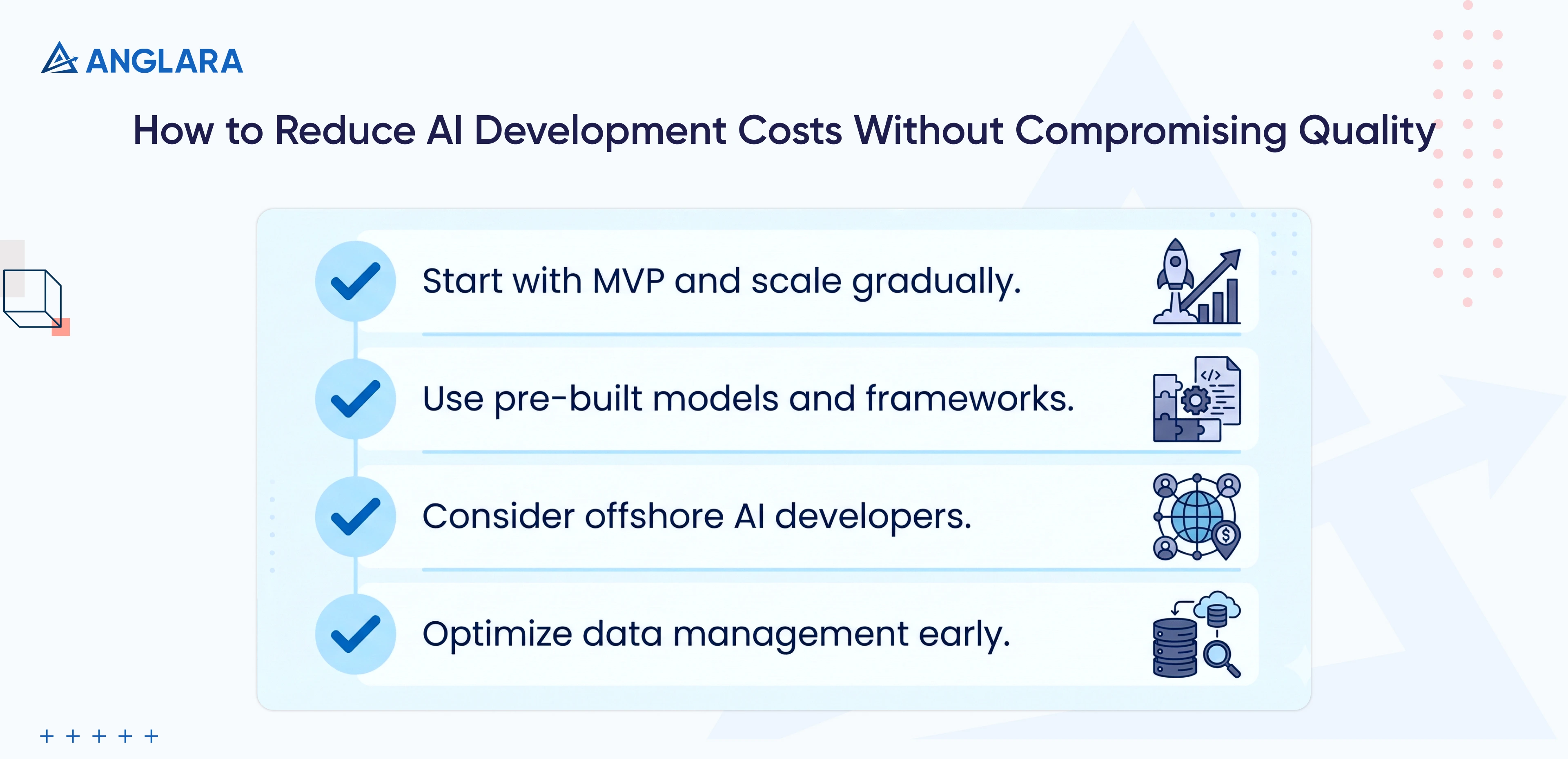
- Start with MVP and scale gradually: An MVP (minimum viable product) costs less, launches faster, and lets you test assumptions before committing big budgets. Once you validate your idea and collect user feedback, you can decide whether to scale before approving the entire development budget.
- Leverage pre-built models and frameworks: Building from scratch costs significantly more than using existing solutions. Using pre-trained models reduces development time and costs. Companies choosing this route often start with API-based solutions. OpenAI's API, Google Cloud's AI services, or specialized platforms handle the heavy lifting so you and your development team can focus on integration rather than training.
- Consider offshore AI developers: Outsourcing to qualified teams in India costs significantly less than hiring in-house without compromising on skills and expertise. The key is choosing vendors with proven track records, security certifications (ISO 27001, SOC 2), and client references in your industry.
- Optimize data management strategies: Data is expensive when handled inefficiently. Invest early in proper data collection, cleaning, and labeling. Your effort up front saves money during model development. Focus data collection on high-impact variables rather than gathering everything.
Hidden costs in AI development you should know
Surprise expenses often derail budgets. But at Anglara, we believe in complete transparency so our clients can plan ahead and get the most out of our partnership and their budget.
Here are three sneaky costs that often catch businesses off guard:
- API and third-party service fees: Most AI projects integrate multiple external services. These aren't free. Simple API integration ranges from a couple of thousand to over $30,000 for complex, customized integrations. Beyond initial setup, subscription fees add up, too.
- Compliance and legal considerations: Compliance isn't optional in regulated industries, and the compliance costs can be staggering. For example, HIPAA compliance for healthcare AI, GDPR compliance for European operations, and emerging AI regulations across jurisdictions add significantly to the initial development cost estimate.
- Model retraining and performance optimization: Your AI model degrades over time as the real world changes. This is called model drift. To avoid it, you need regular monitoring and retraining, which costs additionally and varies depending on update frequency.
Choosing the right AI development partner
You don’t just need someone who can “build a model.” You need a partner who helps you pick the right problems to solve, stays within budget, and is honest about what it will really cost.
That’s exactly how Anglara approaches partnership with our clients. Instead of pushing a one‑size‑fits‑all solution, our team helps you map AI use cases to your goals, budget, and data reality, then plans the entire journey end‑to‑end.
When you evaluate partners, look for someone who will:
- Help you shortlist high‑ROI use cases instead of trying to “AI‑ify” everything at once
- Give a full, line‑by‑line estimate (including data work, integrations, and maintenance), not just a glossy project total
- Explain trade‑offs between “nice to have” and “must have” so you can right‑size scope
- Stay involved after launch with monitoring, improvements, and roadmap planning
With our AI business consulting services, we offer transparent estimates, clear priorities, and no hidden fees. If you want that level of clarity for your next project, schedule a free 30-minute consultation and pressure‑test your AI plans with the team.
