


Your competitors just closed three deals while you were still sorting through last week's leads.
That's the reality gap AI agents create in real estate right now.
While 92% of real estate firms have adopted AI in some form, only a fraction use it to its full potential. And the ones that do? They're seeing 45% increases in lead conversion rates and 30% reductions in marketing costs.
AI agents shouldn’t be just another tech buzzword for the real estate businesses. For real estate professionals overwhelmed by administrative tasks, client communications, and market analysis, they can provide a way to scale operations without increasing headcount.
Curious how? We give you seven AI agent use cases for real estate that can (and already do) transform how brokers, property managers, and real estate tech companies operate.
What are AI agents in real estate?
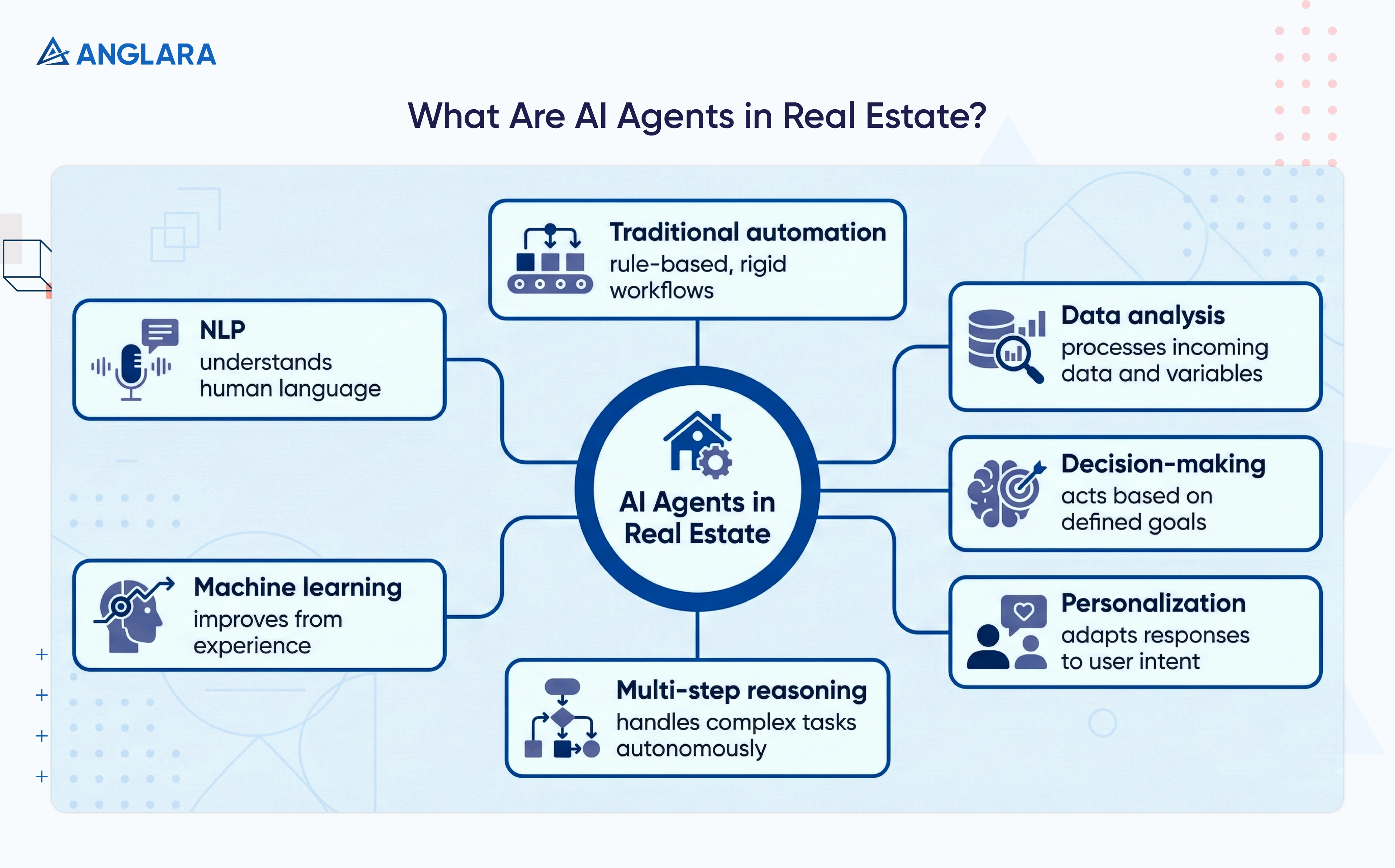
AI agents are quite different from the automation tools you already know.
Traditional automation follows rigid rules, such as if X happens, do Y. So, your CRM sends a follow-up email three days after a lead signs up because you programmed it to do so. It can't adapt when a lead shows sudden urgency or adjust its approach based on market conditions.
However, AI agents can, because they possess the ability to think.
AI agents analyze incoming data, assess multiple variables, make decisions based on goals you set, and take appropriate actions. So, when a lead asks about three-bedroom homes in a specific neighborhood, an AI agent doesn't just send a template response. It sends a personalized response with relevant listings that increase the chances of your lead’s conversion.
And what’s more? This technology combines natural language processing (NLP) to understand human communication, machine learning (ML) to improve from experience, and decision-making frameworks to take action toward defined goals. So, AI agents don’t just operate autonomously, but they also adapt to context, learn from patterns, and handle multi-step reasoning.
Benefits of implementing AI agents in real estate
Before we jump into AI agent use cases for real Estate, let us go over its eight sure benefits:
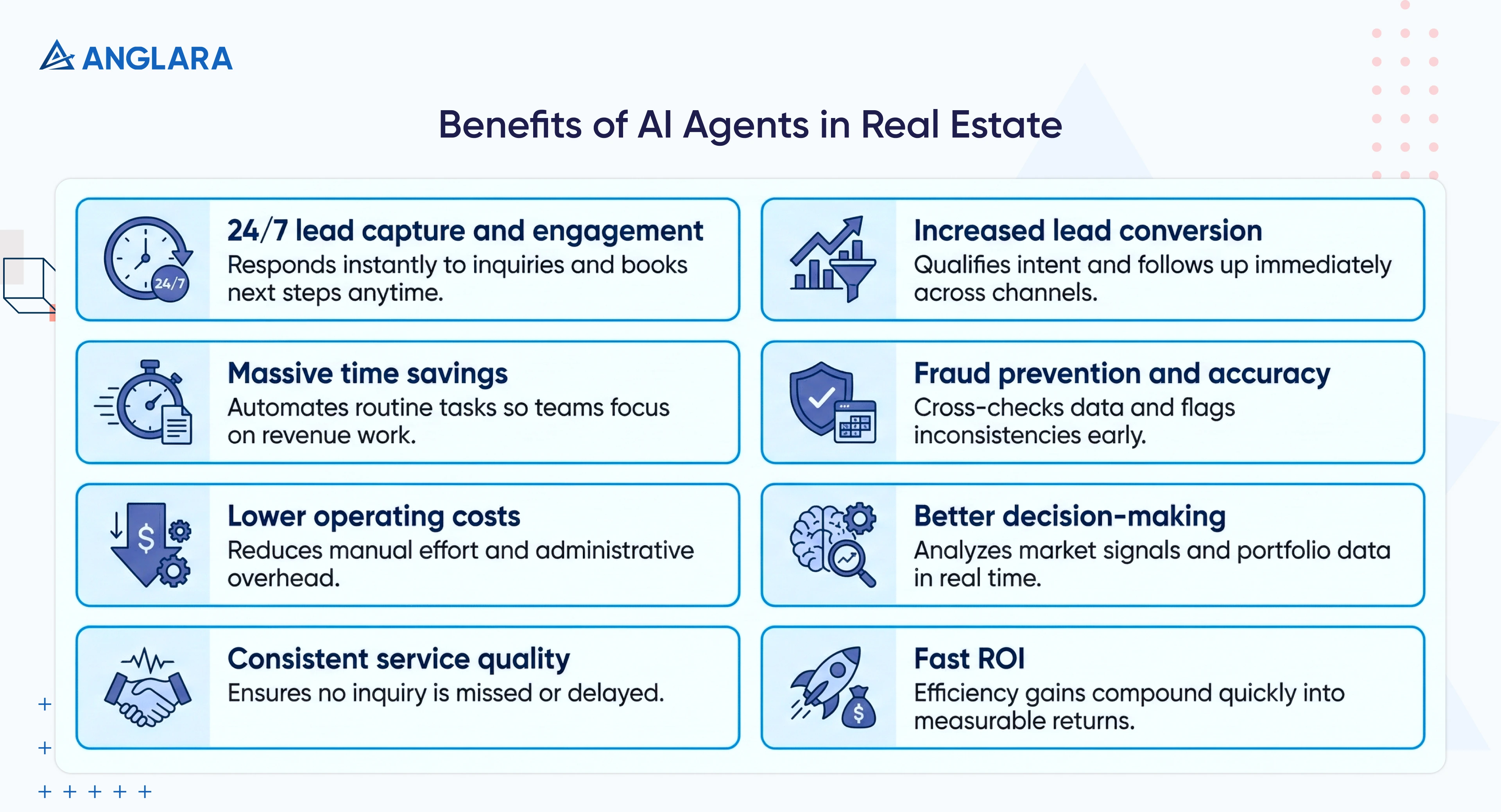
- 24/7 lead capture and engagement: AI agents reply instantly, capture details, and book next steps even when you’re busy or offline.
- Increased lead conversion: AI qualifies intent, prioritizes hot prospects, and follows up immediately across channels to keep buyers engaged.
- Massive time savings: AI automates tenant messaging, scheduling, listings, and follow-ups, allowing your team to focus on revenue-generating work.
- Fraud prevention and accuracy: AI cross-checks applications and extracts contract terms precisely, flagging inconsistencies before they become costly.
- Lower operating costs: AI automates repetitive workflows and streamlines leasing steps, reducing manual labor and administrative overhead.
- Better decision-making: AI analyzes market signals, valuations, and portfolios in real time, informing pricing, offers, and timing.
- Consistent service quality: AI delivers prompt, consistent answers and follow-ups, so no inquiries are missed or delayed.
- Fast ROI: Efficiency gains, shorter cycles, and higher conversion rates compound early, turning savings into returns quickly.
Real-life examples of AI agents in real estate
Enough of benefits in theory, let’s look at how businesses are already using these AI agent use cases for real estate in the real world.
Compass AI-powered agent retention platform
Compass built an AI toolkit so good that it makes top agents’ day-to-day so productive and data-driven that not using its capabilities would mean leaving money on the table.
Their AI-powered platform features a "Likely to Sell" predictive model that analyzes market data to identify potential listings before they enter the open market. Instead of cold calling neighborhoods, agents receive AI-generated leads that show which homeowners are most likely to sell within specific timeframes.
The results of Compass’ AI agent for real estate transformed agent economics. Properties marketed through Compass's 3-Phase Marketing Strategy sell for an average of 2.9% more than those listed directly on the Multiple Listing Service (MLS). On a $750,000 home, that's $21,750 in additional value created purely through AI-optimized market positioning and timing.
That’s not all! Agent retention hit 98% in an industry where top producers regularly switch brokerages for better commission splits. This is an AI-created dependency — agents who rely on ML to surface their next commission don't leave for competitors without that capability.
Redfin's, "Ask Redfin" virtual assistant
Redfin launched Ask Redfin, an AI-powered virtual assistant that provides real-time answers to homebuyers' property-related questions. The system handles inquiries about upcoming open houses, HOA fees, school districts, property features, and neighborhood information.
Redfin adopted a test-driven development approach, utilizing hundreds of test cases to assess the assistant's accuracy in answering questions before deploying it across 14 markets. The engineering team focused on minimizing cost and latency without sacrificing quality by:
- Breaking conversational flows into multiple nodes.
- Evaluating different language model combinations.
- Optimizing prompts at scale.
The implementation saved hundreds of development hours by separating prototyping from production coding.
And, of course, buyers get instant answers without waiting for an agent's availability. In contrast, they redirect their time from answering routine questions to high-value activities, such as negotiations and relationship building.
AI agent use cases for real estate
Compass and Redfin’s use of AI agents demonstrates the potential of AI in the real estate market. And that’s just the tip of the iceberg. There’s so much more you can do with artificial intelligence to support your agents and scale your business with minimal resources.
Here are seven AI agent use cases for real estate you can consider when thinking about integrating AI in your business:
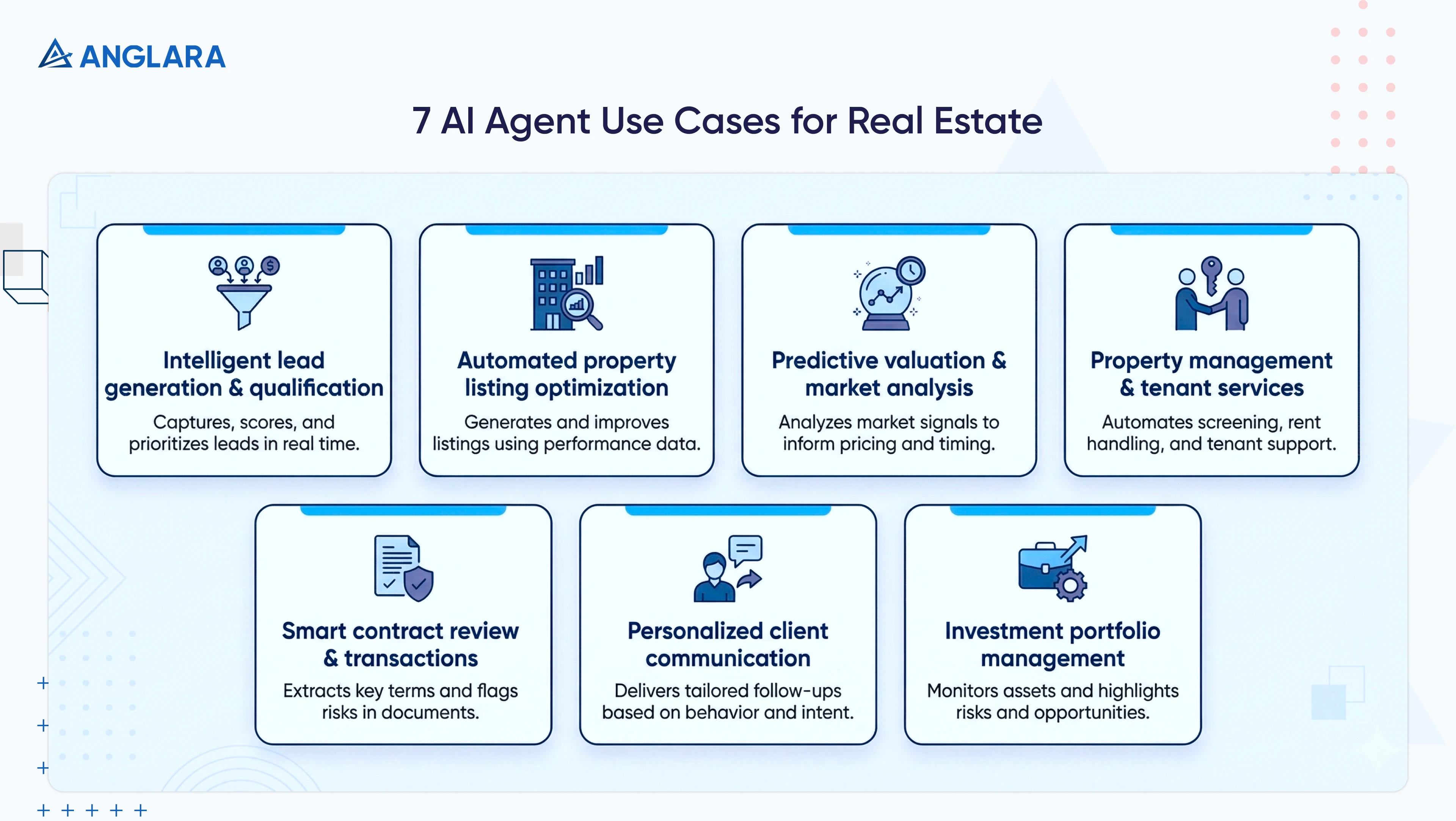
Use case 1: Intelligent lead generation and qualification
Every minute a lead goes uncontacted, your conversion probability drops.
Research shows that real estate companies responding within five minutes are 21 times more likely to convert leads than those waiting longer. But you can't answer every inquiry instantly while showing properties, negotiating contracts, and managing existing clients, can you now?
So, you let AI agents do it (around the clock). They engage prospects the moment interest appears, whether that's 2 PM on Tuesday or 2 AM on Saturday. They analyze consumer data to identify potential buyers and sellers, predict who's likely to transact, and automatically initiate personalized outreach.
The qualification process occurs in real-time. AI agents score leads based on behavioral signals, such as the listings they view, the time they spend on pages, their search patterns, and their engagement with communications.
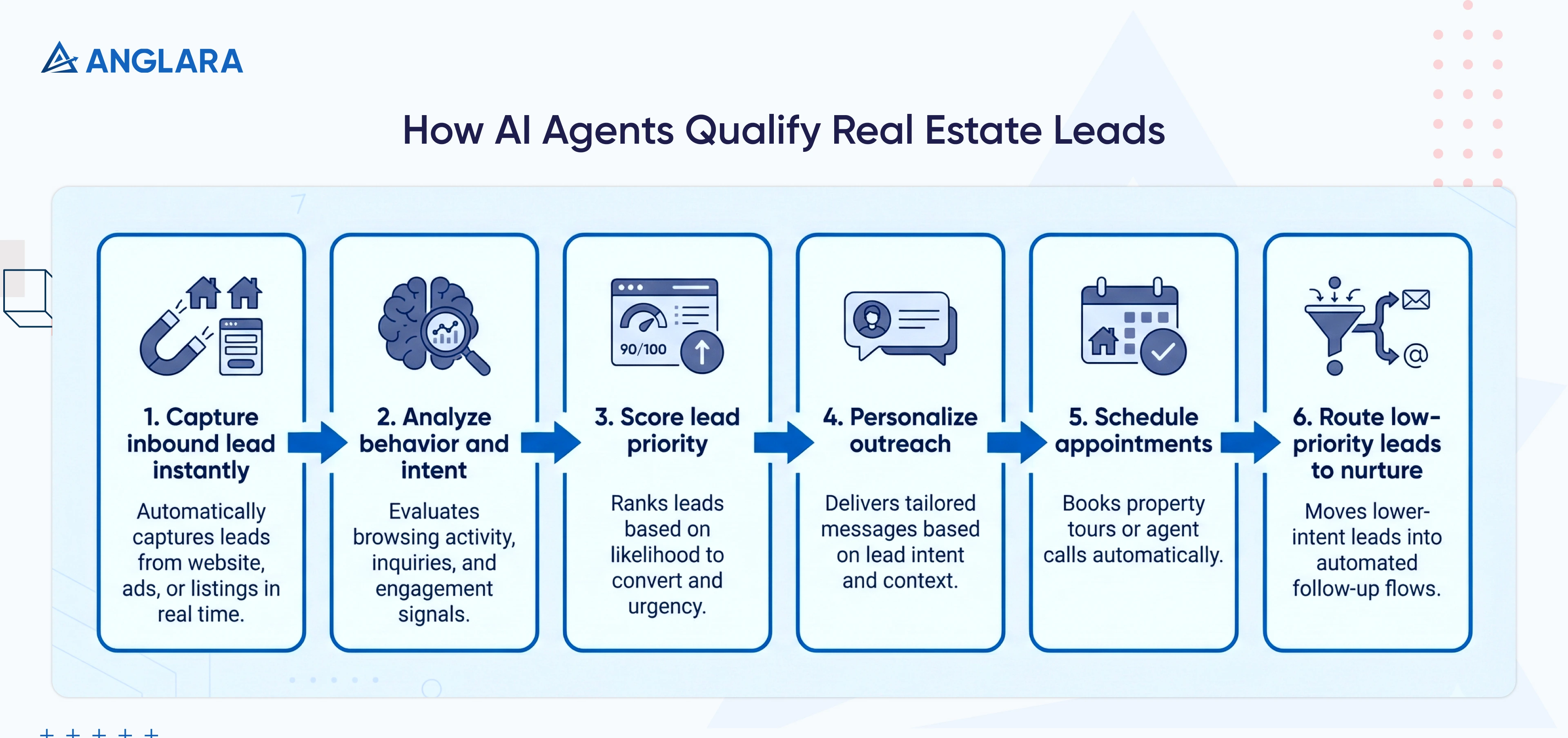
Someone browsing luxury waterfront properties repeatedly gets flagged differently than someone casually looking once every few weeks.
It should come as no surprise that real estate firms using AI for lead generation report a 40-50% increase in qualified lead conversions within the first quarter. Because while you're sleeping, your AI agent captures leads, qualifies them, and schedules appointments.
Properties that show high intent receive immediate attention. Lower-priority leads enter nurture sequences.
AI agents handle hundreds of leads simultaneously, maintaining consistent quality without fatigue or forgetting to follow up. No leads fall through the cracks because someone gets busy. And as a result:
- Lead engagement rates double compared to traditional cold calling and manual follow-ups.
- Customer satisfaction scores improve by 27% due to faster, more personalized responses.
Use case 2: Automated property listing creation and optimization
Writing compelling property descriptions takes 30 to 60 minutes per listing. Multiply that across dozens or hundreds of properties, and you're looking at full workweeks spent crafting copy.
Then there's the inconsistency problem: One agent writes detailed, engaging descriptions, while another rushes through with bare facts. Your brand suffers from the variation.
AI agents generate property descriptions by analyzing what works.
- They study successful listings.
- They identify patterns in language that drive engagement.
- They understand which features matter most to target buyers.
So, you input basic property details, and the system produces polished, SEO-friendly descriptions in seconds.
Additionally, they can continuously optimize by A/B testing different descriptions, tracking which versions generate more inquiries, longer viewing times, and higher conversion rates.
Performance data feeds back into the system, refining future outputs.
Use case 3: Predictive property valuation and market analysis
Traditional appraisals take days and rely on limited comparable sales data.
AI agents analyze vastly more information in seconds. They analyze:
- Historical pricing trends spanning decades.
- Current market trends.
- Neighborhood demographics.
- School ratings.
- Infrastructure development.
- Zoning changes.
- Crime statistics.
- Economic indicators.
The result? Valuations achieve 63-94% accuracy, often exceeding those of human appraisers.
Additionally, AI agents can save hours of investment analysis by also predicting ROI, generating cash flow projections, estimating appreciation potential, and calculating optimal hold periods. So, someone considering a multi-family property receives instant analysis:
- Expected rental income.
- Vacancy rates based on neighborhood trends.
- Maintenance cost projections.
- Predicted value appreciation over the next five years.
And let’s not forget comparative market analysis. When AI agents identify relevant competitors, they can adjust for property differences and generate reports that show how a listing compares to recent sales. Real-time price adjustments happen as market conditions change.
For commercial real estate, this means that AI agents monitor entire portfolios. They track occupancy rates, net operating income, and cash flow across properties to identify underperforming assets and provide strategic recommendations for improvement.
And after digesting all this data, predictive analytics forecast market trends, vacancy patterns, and optimal rent levels. ML models reduce forecasting errors by 68% compared to traditional methods. So, property managers using AI analytics get up to 440% annual ROI driven by predictive maintenance capabilities, accurate market analysis, and risk estimation.
Use case 4: Property management and tenant services automation
Tenant screening typically takes 10 hours per week using traditional methods, which involve tedious tasks such as collecting applications, verifying information, and conducting credit checks, among others.
And let’s not forget the potential for human error.
So, by the time you process an application, a good tenants find other properties.
AI agents compress this timeline dramatically. Automated screening systems can handle all verification tasks, reducing processing time to just two hours per tenant. Additionally, application fraud decreases by 75% because the technology cross-references data across multiple databases, spotting inconsistencies that humans miss. Vacancy periods shrink by an average of 18 days because qualified tenants move through the process more quickly.
Let’s talk rent collection. With AI agents, you don’t need to deal with the hassle of reminding your tenant to send payments manually. The agent will send reminders, process transactions, flag late payments, and initiate appropriate collection procedures as needed.
Lease agreement generation can also be left to the agent, which takes into account property details and local regulations. Some other things it can handle are:
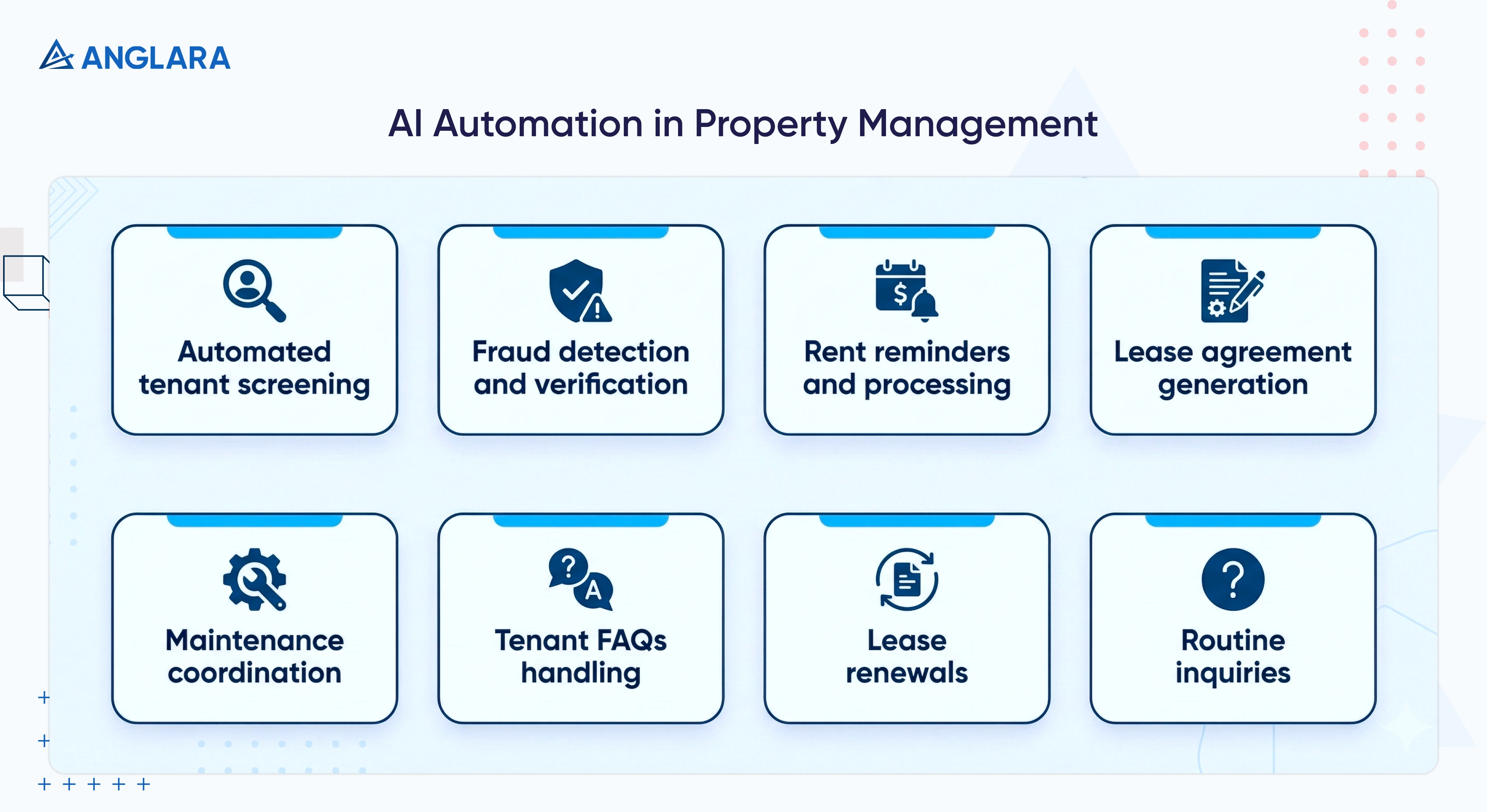
- Maintenance coordination
- Tenant’s FAQs
- Lease renewals
- Routine inquiries
By eliminating redundant tasks, property management teams can save up to 10 hours per employee per week, freeing up that capacity for complex problem-solving and relationship-building.
Call volumes decrease by up to 10%, while resident satisfaction improves by 5%. A 15% increase in retention rates is a significant bonus you receive when tenants receive faster, more consistent service.

Stop Losing Quality Tenants
Automate screening and reduce vacancy periods by 18 days on average.
Book a CallUse case 5: Smart contract review and transaction processing
Closing real estate deals involves reviewing dense legal documents filled with critical terms. Reading through 90-page commercial lease agreements manually takes 4 to 8 hours. That's time you're not spending closing more deals.
But when AI does it, it’s a matter of minutes. AI agents can:
- Review purchase agreements.
- Identify closing dates.
- Locate contingencies.
- Flag special provisions.
- Highlight items requiring immediate attention.
AI agents also extract critical terms, such as renewal dates, rent escalation clauses, compliance requirements, and payment schedules. Human abstractors miss details after hours of reading dense legal language. On the other hand, AI maintains the same level of attention from the first page to the last, reducing the 10% material error rate commonly found in manually abstracted documents.
Thus, the accuracy reaches 95%, the processing time decreases by 90%, and costs drop by approximately 50%.
Use case 6: Personalized client communication and relationship management
Most leads never convert because follow-up is inconsistent.
You intend to send that market update, and plan to check in with the client who viewed properties last month. However, that follow-up never happens because closings pile up, new leads arrive, and existing clients require attention.
Then, the lead buys from someone who stayed in touch.
If only you’d invest in AI agents, they could maintain those relationships systematically. They can:
- Send personalized market updates based on each client's interests.
- Recommend properties that match stated preferences and browsing behavior.
- Execute automated follow-ups at optimal times.
The personalization extends beyond basic demographics to include interaction history, search patterns, and engagement levels.
CRM capabilities become agentic. Instead of just storing contact information, the system actively manages relationships. It automatically updates records, tracks engagement across channels, scores lead quality in real-time, and recommends next actions.
And as we know, in the real estate market, timing matters enormously. AI agents identify when clients are likely to transact based on behavioral signals, suggest optimal outreach moments, and automatically draft personalized email and text communications. So, someone browsing listings intensely over several days triggers different outreach than someone checking occasionally.
Use case 7: Investment portfolio analysis and management
Managing commercial real estate portfolios involves tracking dozens of properties simultaneously to identify opportunities and risks. You need to monitor occupancy rates, maintenance schedules, lease expirations, and other key data points across the board.
It consumes a significant amount of time, and by the time you spot an underperforming asset, you've already lost revenue.
AI agents’ ML models can process thousands of data points per property and identify undervalued commercial real estate opportunities. Additionally, its precision is beyond the capabilities of human analysts to achieve. They can continuously monitor portfolios to track performance metrics across all properties and compare actual results against projections.
So, when occupancy drops below expected levels, rental income falls short of targets, or expenses exceed budgets, the system flags the asset immediately.
Plus, its predictive analytics capabilities can also analyze market trends to predict vacancy rates. It can recommend rent optimization strategies and identify when market conditions favor acquisition or disposition.
Lastly, financial reporting automation eliminates the need for manual spreadsheet work. AI agents can generate customized reports showing portfolio performance, expense tracking, vendor payment status, and budget variance analysis.
These reports are updated in real-time as new data becomes available.
Institutional investors utilizing AI for portfolio management report annual performance improvements of 8-12% through better-informed decisions and enhanced asset management. The technology reduces error margins in valuation models and aligns financing terms more accurately with expected returns.
Our AI agent implementation plan
You want results, not another tool to babysit. Anglara builds AI agents that plug into your workflows, respect compliance, and move the numbers you care about. With us, you get a structured rollout plan, proven industrial know-how, and expert support at every step. Here’s our 12-week implementation timeline:
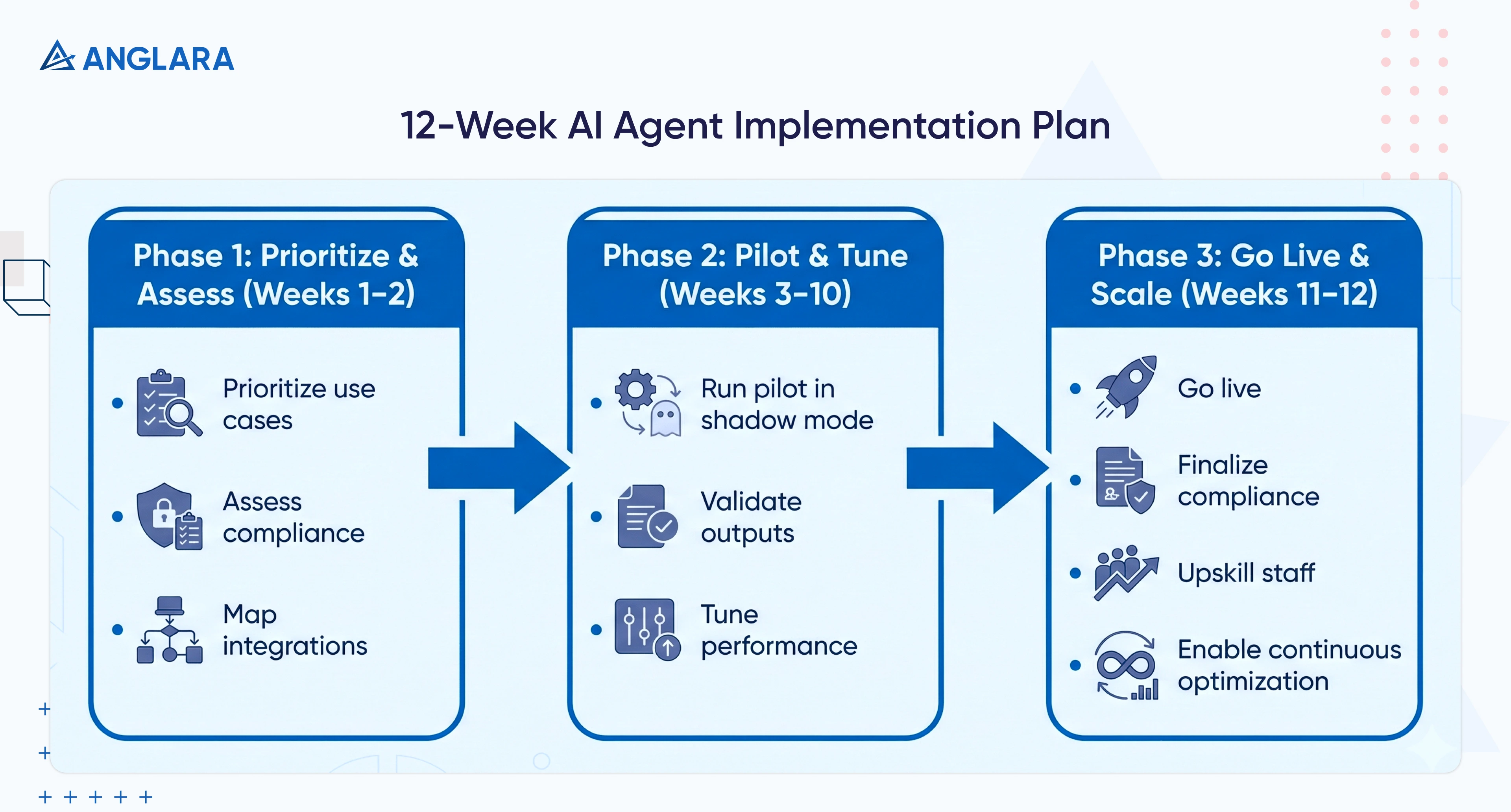
- Week 1–2: Prioritize high-impact use cases, assess compliance, and map integrations with your CRM, PMS, MLS, and comms stack.
- Week 3–10: Run a pilot in shadow mode, validate outputs with your team, and tune performance using real conversations and workflows.
- Weeks 11–12: Go live, finalize compliance checks, upskill your staff, and set continuous optimization to compound gains.
Agencies that choose Anglara see quick wins and scalable AI solutions that deliver tangible results. Ready to see what AI agents can do for your brokerage or portfolio? Schedule a complimentary 30-minute consultation to explore your options and get a quote.
Frequently asked questions
Can AI agents integrate with our existing CRM and property management systems?
Yes. We connect to your CRM, PMS, MLS, and comms stack via APIs for bi-directional data sync and workflow automation.
What's the typical ROI timeline for implementing AI agents in real estate?
Most teams see measurable gains within one or two quarters as lead conversion, leasing speed, and ops efficiency improve.
How much does it cost to implement AI agents for a real estate business?
It depends on scope, integrations, data readiness, security, and support needs. Book a complimentary consultation with one of our experts to receive a customized quote.
Will you provide a customized solution based on our needs?
Yes. Anglara offers custom AI development services to design solutions that fit your workflows, compliance needs, tech stack, and KPIs.
What happens if an AI agent makes an error or provides incorrect information to a client?
It’s rare as our models are extensively trained on your historical data and industry knowledge base. However, suppose they don’t have an appropriate answer to your client's query. In that case, it escalates to an agent with full context, and they learn from the resolution to better address similar queries in the future.
